For many decades, the official dietary recommendation for protein was a single number supposedly suitable for everyone: 0.8 grams per kilogram of body weight per day. A 25-year-old and a 75-year-old received the same instruction. But there is a fundamental problem with this picture: this number was not designed for you to thrive, but only to prevent you from suffering a deficiency. It is the minimum threshold that prevents measurable protein loss in a young, sedentary adult, not the threshold that preserves muscle mass, strength, and functional independence over decades. And when it comes to healthy aging, this difference is critical.
The real question is not "how much protein do I need to survive," but how much protein for healthy longevity, one where you get up from a chair on your own at age 85, carry your grandchild, and climb stairs without a second thought. The scientific answer surprises many: as you age, the need for protein does not decrease, it actually increases.
What is Anabolic Resistance?
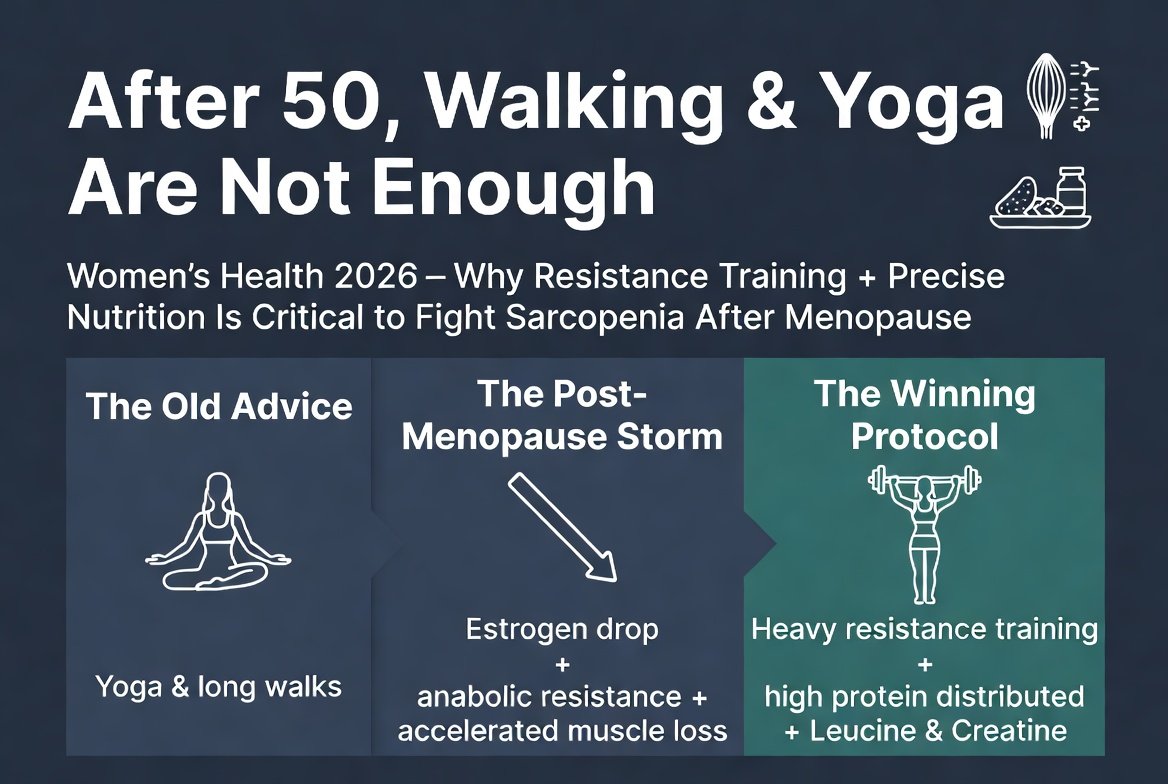
The main reason older adults need more protein has a scientific name: Anabolic Resistance. This is a phenomenon where the same amount of protein produces a weaker building response in the muscle of an older person compared to a younger person.
- In a young person: A 20-gram protein dose fully activates the muscle protein synthesis mechanism.
- In an older person: The same 20-gram dose activates the mechanism only partially. The body simply "listens" less to the signal.
- The reasons: Decreased insulin sensitivity in muscle, reduced blood flow to muscle tissue after a meal, and increased breakdown of amino acids in the gut and liver before they even reach the muscle.
- The result: If an older adult eats exactly as they did at age 30, their muscle gradually shrinks. Not because they eat less, but because their body utilizes the same amount less efficiently.
This is why science talks about the Leucine Threshold: to overcome anabolic resistance, an older adult needs a protein dose large enough to provide about 2.5 to 3 grams of the amino acid leucine in one meal. For a young person, this amounts to 20-25 grams of protein, but for an older adult, it is often 30-40 grams per meal.
The Connection to Longevity: Muscle is an Organ for a Long Life
Why do we even care about muscle when talking about lifespan? Because muscle is much more than strength. It is a metabolic and endocrine organ that affects the entire body.
Higher muscle mass is linked to better insulin sensitivity, normal blood sugar control, and a lower risk of diabetes. Muscle secretes myokines, proteins that communicate with the brain, immune system, and fat tissue, reducing chronic inflammation, one of the main drivers of aging. And at the simplest level: strong muscle means fewer falls, fewer fractures, and more years of independent living.
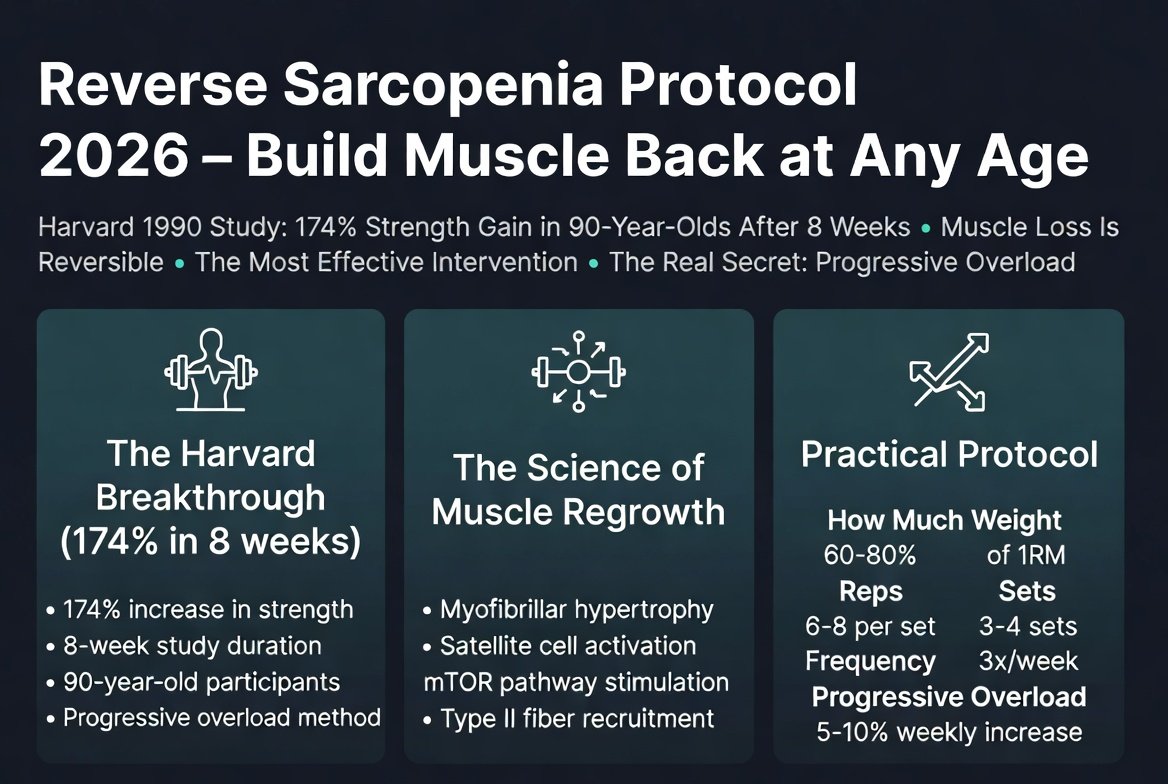
When muscle wears down, sarcopenia develops, the age-related loss of muscle mass and function. The process begins as early as the 30s at a relatively slow rate, about 3% to 8% loss of muscle mass per decade, and accelerates significantly after age 60, when the loss rate increases to about 1% per year. Sarcopenia is one of the world's leading causes of loss of independence in old age. Adequate protein, along with movement, is the main dietary defense line against it.
Current Evidence
Study 1: The PROT-AGE Group from 2013
An international expert group led by Jurgen Bauer published a comprehensive position paper on optimal protein intake for older adults in the Journal of the American Medical Directors Association. The conclusion: the RDA of 0.8 g/kg is insufficient for adults over 65. Their recommendation is at least 1.0 to 1.2 g/kg per day for a healthy older adult, and 1.2 to 1.5 g/kg for an older adult with a chronic disease or in recovery. The group explicitly emphasized anabolic resistance as the biological reason for the increased need.
Study 2: The ESPEN Group from 2014
The European expert group for clinical nutrition (ESPEN), led by Nicolaas Deutz, published recommendations in Clinical Nutrition that aligned with those of PROT-AGE: 1.0 to 1.2 g protein per kg per day for a healthy older adult, and up to 1.5 g and more in illness or injury. The main innovation: ESPEN emphasized that protein alone is not enough, and combining it with physical activity, especially resistance training, is a necessary condition for the protein to actually translate into muscle.
Study 3: Morton's Meta-Analysis from 2018
One of the most influential works in the field was published in the British Journal of Sports Medicine by Robert Morton and colleagues. The researchers analyzed 49 studies with 1,863 participants and examined the effect of protein supplementation on gains in muscle mass and strength combined with resistance training. The finding: protein supplementation significantly increased strength and lean mass. A critical point: the benefit continued up to an intake of about 1.6 g/kg per day, and beyond that, no additional benefit for muscle building was found. This is the numerical basis for the recommended upper range.
How Much is on the Plate? Distribution Throughout the Day
Let's translate the numbers. A person weighing 70 kg aiming for 1.4 g/kg needs about 98 grams of protein per day. But the daily amount is only half the story. Due to anabolic resistance, proper distribution is almost as important as the total amount.
A common mistake: people eat a low-protein breakfast (a slice of bread with jam), a moderate lunch, and a high-protein dinner. In practice, most protein is concentrated in one meal, and the body cannot "store" it. It is better to aim for 25 to 40 grams of protein in each of 3 to 4 meals, so that each meal crosses the leucine threshold and triggers muscle building anew.
- Morning: This is the weakest meal for most people, and where the biggest improvement can be made. Add eggs, Greek yogurt, or cheese.
- Lunch and Dinner: A palm-sized portion of meat, chicken, fish, or legumes at each meal.
- Post-Workout: A high-protein meal in the hours after resistance training takes advantage of a window where the muscle is particularly sensitive to building.
Protein Sources: From Real Food, Including Plant-Based
The emphasis here is important: the goal is protein from food, not from powder. Whole food provides not only protein but also iron, zinc, B vitamins, calcium, and fiber, a complete nutritional matrix that isolated powder does not provide. Here are excellent sources and how much protein they provide:
- Large egg: About 6 grams of quality protein.
- Chicken breast (100g): About 25-31 grams.
- Salmon or tuna (100g): About 22-25 grams, plus omega-3.
- Cottage cheese (100g): About 11-12 grams.
- Greek yogurt (170g): About 17 grams.
- Cooked lentils (1 cup): About 18 grams, plus fiber and iron.
- Chickpeas and tofu: About 15-20 grams per serving, an excellent plant source.
For those who eat plant-based: This is entirely possible, but requires planning. Plant proteins are often missing one or more amino acids and contain less leucine, so it is advisable to vary sources (legumes with grains) and slightly increase the total amount. A combination of lentils, beans, tofu, tempeh, edamame, quinoa, and nuts can provide everything needed. Due to anabolic resistance, older plant-based eaters should be especially careful to have generous protein portions at every meal.
Is More Protein Always Better? The Limitations
It is important to maintain balance and not fall into extremes. A few evidence-based caveats:
- Ceiling of benefit: As Morton's meta-analysis showed, beyond 1.6 g/kg there is no additional benefit for muscle building in most people. More protein does not equal more muscle without limit.
- Kidney disease: Anyone suffering from chronic kidney disease must consult a doctor before increasing protein intake. For them, the general recommendations are not necessarily valid.
- Protein without movement: Protein without muscle stimulation is half a solution. Resistance training is the necessary partner, as ESPEN emphasized. Combining strength training with a protein-rich diet is the winning pair for muscle preservation.
- Quality vs. quantity: Protein from highly processed sources (sausages, processed meat) comes with unhealthy additions. Lean meat, fish, eggs, and legumes are preferable.
What to Take from the Research?
- Calculate your target: Multiply your body weight in kg by 1.2 to 1.6. A 65 kg woman needs 78-104 grams of protein per day. This is enough to fight anabolic resistance.
- Distribute, don't concentrate: Aim for 25-40 grams of protein at each meal, especially upgrade breakfast, which for most of us is low in protein.
- Prefer real food: Eggs, fish, chicken, yogurt, lentils, tofu. The complete nutritional matrix is superior to an isolated substitute.
- Combine with movement: Protein without resistance training will not build muscle to its full potential. Both together, or nothing.
- If you are vegetarian or vegan: Vary sources, slightly increase the total amount, and ensure generous portions at each meal.
The Broader Perspective
For years, we perceived protein as something for bodybuilders, and aging as something requiring eating "less." Science has overturned both assumptions. As you age, the need for protein increases, not decreases, and this is one of the most important dietary adjustments you can make for a long and independent life. It doesn't start and end with the total amount alone, but with distribution, quality, and combination with movement.
Your plate is a powerful tool for healthy aging. If you would like to build a personalized plan, you are welcome to build personal nutrition principles that combine protein, timing, and movement according to your age and goals. The muscle you preserve today is the independence you will enjoy twenty years from now.
References:
Bauer J et al. (2013), PROT-AGE Study Group, J Am Med Dir Assoc
Deutz NE et al. (2014), ESPEN Expert Group, Clinical Nutrition
Morton RW et al. (2018), British Journal of Sports Medicine

💬 Comments (0)
Be the first to comment on the article.