Every five years, the field of aging research undergoes a technological upheaval. First it was DNA sequencing, then methylation and epigenetic clocks, then single-cell RNA sequencing (scRNA-seq). Now we are in the midst of another revolution: spatial genomics, the ability to know not only which genes are active in a cell, but exactly where that cell sits within the tissue, who its neighbors are, and what it signals to them.
The problem: until now, spatial mapping required specialized microscopes, expensive cameras, and labs with heavy optical infrastructure. Most labs in the world, and certainly most labs in Israel, could not afford it. And here enters a new study published in the journal Nature Neuroscience on May 12, 2026, from the lab of Prof. Junyue Cao at Rockefeller University (lead researchers: Abdulraouf Abdulraouf and Weirong Jiang).
The researchers present a new method called IRISeq (Imaging Reconstruction using Indexed Sequencing), an optics-free method that achieves spatial mapping without a microscope and without an expensive imaging system. They applied it to brains of mice of different ages, revealing a brain aging map at a resolution never seen before. It is important to emphasize right now: all the research was done in mice only, with no human brain tissue.
What is spatial genomics anyway?
In regular RNA sequencing, we take tissue, break it down into individual cells, and ask: which genes are active in each cell? The result: a list of cells with gene expression profiles. But we lost the location information. Where was the cell? Who were its neighbors? What passed between them?
- Spatial genomics solves the problem: it measures gene expression while preserving the original coordinates of each cell within the tissue.
- This is critical in the brain, an organ where every function is based on architecture: layers in the cortex, nuclei in the hippocampus, connectivity pathways.
- Existing technologies (e.g., Visium from 10x Genomics, MERFISH from Vizgen) require specialized fluorescence cameras, imaging platforms, and expert teams.
- The cost per experiment: according to the study, existing methods often cost over $1,000 per tissue section, beyond the cost of the equipment.
What IRISeq does differently
The new method uses a different physical principle. Instead of seeing a fluorescent signal under a microscope, it encodes the location within the DNA sequence itself. The tissue is placed on a substrate of millions of tiny beads (micrometers in diameter), each carrying a unique barcode. The beads exchange DNA-based signals with their close neighbors, so that when standard sequencing (regular Illumina) is run, it is possible to computationally reconstruct both which genes were expressed and exactly where each cell was in the tissue, without a microscope.
Advantages:
- No need for a microscope. Any lab with a standard sequencing machine can run the experiment.
- The cost drops by an order of magnitude: about $30 per section (less than $1 per square millimeter), compared to over $1,000 per section with existing methods.
- Adjustable resolution, in the range of about 5 to 50 micrometers, by changing the bead size, down to the single-cell level.
- Preservation of the spatial architecture of the tissue.
This is true democratization: the technology becomes accessible to medium-sized academic labs, university hospitals, and developing countries. Expect a significant increase in spatial genomics studies in the coming years.
What they discovered in the aging brain
This is a single, integrated study, not four separate studies. The researchers mapped over 70 coronal sections from C57BL/6 mouse brains, including two lymphocyte-deficient models (Rag1 and Prkdc mutants), and compared adult mice aged 4 months versus old mice aged 23 months. In total, about 460,000 spatial expression profiles were generated, and over 300 cell subtypes were mapped across about 30 different brain regions.
1. Inflammation concentrates in the white matter
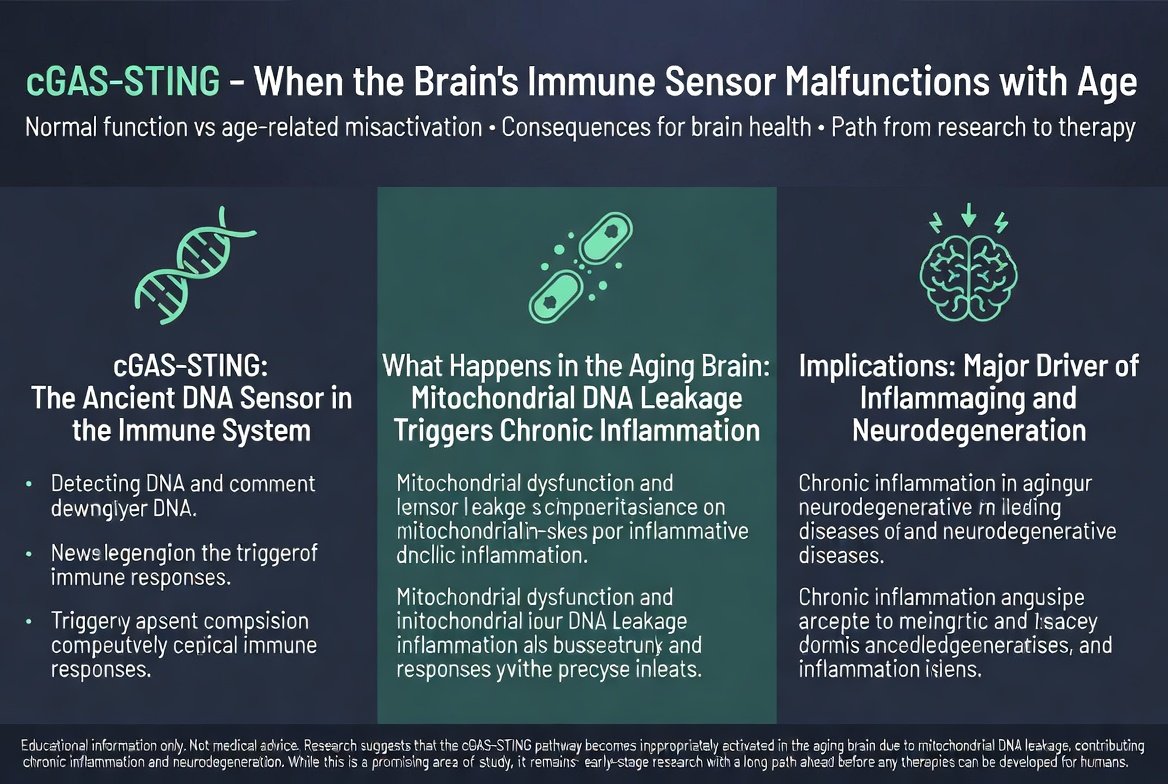
The main finding is neuroinflammation in the white matter. The researchers identified an inflammatory cellular "neighborhood" where three types of glial cells cluster together in the old brain: DAM-type inflammatory microglia (disease-associated microglia), reactive oligodendrocytes, and activated astrocytes. The spatial method showed that these cells are not only more abundant in old age but sit and interact with each other in the same areas, something regular single-cell sequencing (which dissociates the tissue) cannot reveal.
2. Lymphocytes drive inflammation near the ventricles
A second and surprising finding: immune cells of the lymphocyte type played a central role in driving inflammation in the aging brain. Using the lymphocyte-deficient models, the researchers showed that genes from the complement and interferon pathways were specifically upregulated in specific areas, mainly around the ventricles, the fluid-filled cavities in the brain, and in the white matter. That is, part of the brain inflammation in aging depends on the presence of lymphocytes.
3. Decline in new neuron formation in the SVZ
Third, a cell-focused analysis identified a significant decrease in cells related to neurogenesis in the Subventricular Zone (SVZ) of old mice, including neuroblasts and neuronal progenitor cells. The SVZ is one of the few areas where the adult brain continues to produce new neurons, and aging depletes this cell pool. This is a finding in mice about progenitor cells; the study did not test cognition.
What implications does this have for aging research?
The ability to map brain aging at such resolution, and at low cost, opens new doors:
- Identifying precise drug targets: if inflammation concentrates in a specific neighborhood of microglia, oligodendrocytes, and astrocytes in the white matter, interventions can be targeted precisely to those cells and areas.
- Understanding the role of the immune system: the dependence of inflammation on lymphocytes offers a new research direction regarding the connection between the immune system and brain aging.
- Testing interventions: senolytics (fisetin, quercetin), rapamycin, metformin, intermittent fasting. Interventions that claim to slow brain aging can now be tested more precisely, region by region, in mice.
- Research accessibility: the low cost allows running many more experiments and mapping many more samples than was possible until now.
Should we be excited?
The technology is impressive, but there are important limitations:
- This is a young method. It needs further validation in independent labs before becoming a widespread standard.
- The bioinformatic analysis is complex. Each experiment generates vast amounts of data requiring specialized expertise to decode.
- Resolution is not everything. Knowing which gene is expressed where does not mean you understand causality. Functional experiments are still needed.
- Everything is in mice. The study did not test human brain tissue or measure cognition. The leap from mouse to human is not trivial, and any clinical implication is still far off.
Additionally, it is important to understand: this is a tool, not a drug. IRISeq will not slow aging; it only helps us understand it. Clinical interventions still need to be developed separately.
What can be taken from the study today?
The study itself is in mice and deals with technology, not lifestyle recommendations. However, it reinforces a picture already known from other studies: chronic inflammation and glial cell health are key players in brain aging. In this context, habits that other studies link to a healthy brain remain relevant:
- Anti-inflammatory diet. A Mediterranean or MIND diet, and reducing ultra-processed food and sugar, are linked in the literature to lower inflammation.
- Regular aerobic activity. In other studies, physical activity has been linked to reduced inflammation and improved brain health. About 150 minutes per week is a common target.
- Quality sleep. The glymphatic system clears brain waste mainly during deep sleep. 7-9 hours, a dark room, less screen time before bed.
- Continuous cognitive stimulation. Learning a new language, musical instrument, or complex skill builds cognitive reserve.
- Follow the research. Tools like IRISeq are a step toward better understanding of brain aging, not a solution in themselves.
The broader perspective
The IRISeq story is an excellent example of the development of aging research over the past decade. We have moved from measuring lifespan, to identifying genes, to mapping methylation, to single-cell sequencing, and now to spatial maps of whole tissues. Each such leap opens a wider window into how the body ages.
The more important lesson: aging is not a uniform event. It is a heterogeneous, local, cell-type-specific process. One area of the brain may age at a different rate than another, and glial cells may lead the inflammatory process in certain areas before neurons suffer.
In years to come, there may be a much more precise spatial diagnosis of tissue aging, and the tools that build this future are being created now. IRISeq, for now in mice, is one of them. Aging is not a decree of fate; it is a process that can be measured, understood, and perhaps later modified.
References:
Nature Neuroscience, 2026: Optics-free spatial genomics for mapping mammalian brain aging by IRISeq



💬 Comments (0)
Be the first to comment on the article.