"Solving aging" was for decades a speculative statement. Skepticism was a polite word for a calculated statement. Now, in 2026, the conversation has changed. With artificial intelligence capable of scanning trillions of molecules a day, and with the world's first clinical trial of reprogramming starting in the clinic, experts are beginning to talk about a "first longevity drug" within the coming decade. What changed? How is AI accelerating the process? And is this the time it's really happening?
The Trouble with Aging
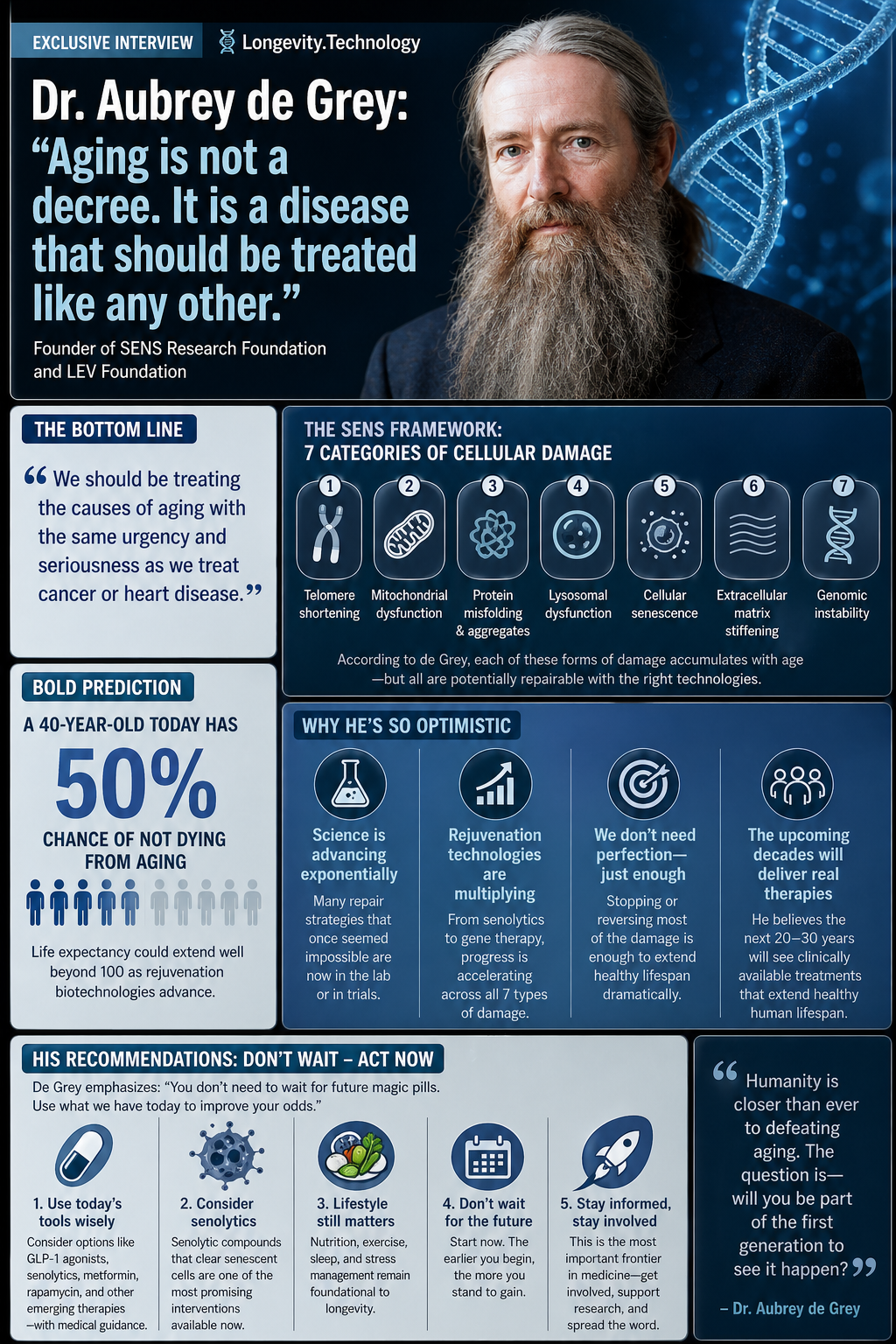
Researchers describe aging as the hardest problem in medicine, for a simple reason: it is not one disease. Instead, it is hundreds of mechanisms working simultaneously: DNA damage, tired mitochondria, damaged proteins, zombie cells, shortening telomeres, faulty epigenetics, a weakening immune system. If you solve one, the rest continue. If you solve five, the body finds a way to bypass them.
The classic academic lab worked on one mechanism at a time. With 200+ mechanisms, it would take 1000 years to cover everything.
The Solution: AI Scans Instead of a Scientist
This is where artificial intelligence comes in. Instead of a scientist testing a thousand molecules a year, an algorithm tests a billion molecules a day. And that's just the beginning. AI can:
- Predict the three-dimensional structure of proteins. This used to be a step that took a year. With DeepMind's AlphaFold, it takes minutes.
- Screen molecules that fit a target. Instead of manual experiments, large-scale simulation.
- Identify drugs already approved for other areas. Drug repurposing - saving 10 years of time per target.
- Predict side effects. Eliminate dangerous candidates before a patient receives them.
- Find connections a human wouldn't see. AI identifies patterns in data spanning millions of patients.
The Numbers: Much Faster
In one field, AI is already changing everything. Insilico Medicine, a company with headquarters in Hong Kong and Boston and offices worldwide, used AI to go from a biological target to a drug candidate for pulmonary fibrosis (rentosertib / INS018_055, a TNIK inhibitor) in about 18 months in the early discovery phase. Previously, the same phase would have taken 6-7 years. It is important to clarify: this refers only to the early discovery phase, and after that the drug underwent years of clinical trials (Phase IIa results were published in 2025), so this is not a finished drug in 18 months.
According to the consulting firm McKinsey, AI significantly shortens the initial drug discovery phases. If we add the time for clinical trials (which are still physically limited), the total time for a new drug may drop from 15 years to 7-8 years.
The Critical Step of 2026: The First FDA Trial
At the end of January 2026, Life Biosciences, founded by David Sinclair, received FDA approval for the first human clinical trial of partial epigenetic reprogramming (ER-100 treatment). This is not a longevity drug. It is a treatment for the eyes of glaucoma patients (and later NAION). But the mechanism - the three Yamanaka factors (OCT4, SOX2, KLF4) - is the same mechanism that can make cells younger throughout the body.
What does this mean? If this trial succeeds, it will serve as a proof of mechanism: partial reprogramming is safe for humans. This is the critical step without which all the promises of anti-aging were just theory. However, it is important to remember that this is a proof of mechanism and not a longevity drug.
The trial is described as a breakthrough: not one that will stop aging, but one that can prove the mechanism of cellular rejuvenation is safe in humans.
The Five "Billionaires" Changing the Field
The capital flowing into anti-aging companies is the reason for the pace. Here are the five biggest leaders:
- Jeff Bezos: Invested in Altos Labs ($3 billion raised), the largest in the world
- Sam Altman (OpenAI): Invested in Retro Biosciences (goal: add 10 years of healthy life)
- Brian Armstrong (Coinbase): Founder of NewLimit, which focuses on partial epigenetic reprogramming of aging cells (leading results are in human liver cells)
- Larry Page (Google): Announced and backed Calico (2013); the company is run by Arthur Levinson, and the research partnership with AbbVie alongside Alphabet reached approximately $2.5 billion
- Peter Thiel: Multiple investments in all the companies. His well-known stance: he prefers to "fight" death rather than accept it, and sees it as a solvable problem.
Not All Rosy: The Cautionary Notes
Some experts are more cautious. Prof. Eric Topol, a renowned cardiologist, says we still have no proof that aging is reversible in humans. In the context of cellular rejuvenation methods, he put it sharply: "The only thing we have that looks great is in mice. We don't have things that work in humans."
A recurring message: what works in mice doesn't always work in humans. And that's true. But even in mice, we are seeing results we wouldn't have dreamed of in 2010. This was the most disappointing field, and it has become one of the most promising.
The Risk: High Expectations
A major problem: public expectations are too high. People hear "longevity drug" and think "a pill that will make me live to 150." The reality is more modest:
- Stage 1: A drug that reduces the risk of 2-3 age-related diseases (Alzheimer's, Parkinson's, diabetes)
- Stage 2: A drug that slows overall aging by 10-20%
- Stage 3: A drug that takes a 70-year-old and returns them to the function of a 60-year-old
- Stage 4: Extending the life expectancy of the entire group by 10+ years
We are now at Stage 1. Stage 2 is 5-7 years away. Stage 3 - 10-15 years. Stage 4 - unknown.
What Can You Do Now?
Even without a drug, there are two simple things:
- Stay alive and healthy to be part of the wheel. People who were 50 in 1990 saw the AIDS drugs. People who will be 50 in 2030 may see the anti-aging drugs. Therefore, physical activity, nutrition, and sleep are an investment in the future.
- Follow the research. In the coming years, clinical trials will be published one after another. A person who follows will be able to connect in time.
The Bottom Line
2026 is a real turning point. AI is dramatically accelerating research. Billions of dollars are flowing. The first clinical trial of reprogramming is starting. Even if 90% of expectations are not met, the 10% that are realized will change the world. This is perhaps the first time in human history that we are truly beginning to try to reverse aging, not just talk about it.


💬 Comments (0)
Be the first to comment on the article.