Senolytics—drugs that kill zombie cells—are one of the biggest promises in anti-aging. Until now, most senolytics worked in a similar way: they block anti-apoptotic proteins (like BCL-2) and allow the zombie cell to "commit suicide" via apoptosis. But a new study published in Cell Press Blue in 2026 presents a completely new approach: polyunsaturated fatty acids (PUFAs) that kill zombie cells through a different mechanism—ferroptosis, an iron-driven cell death. A team of researchers from the University of Minnesota suggests this is the next generation of senolytics.
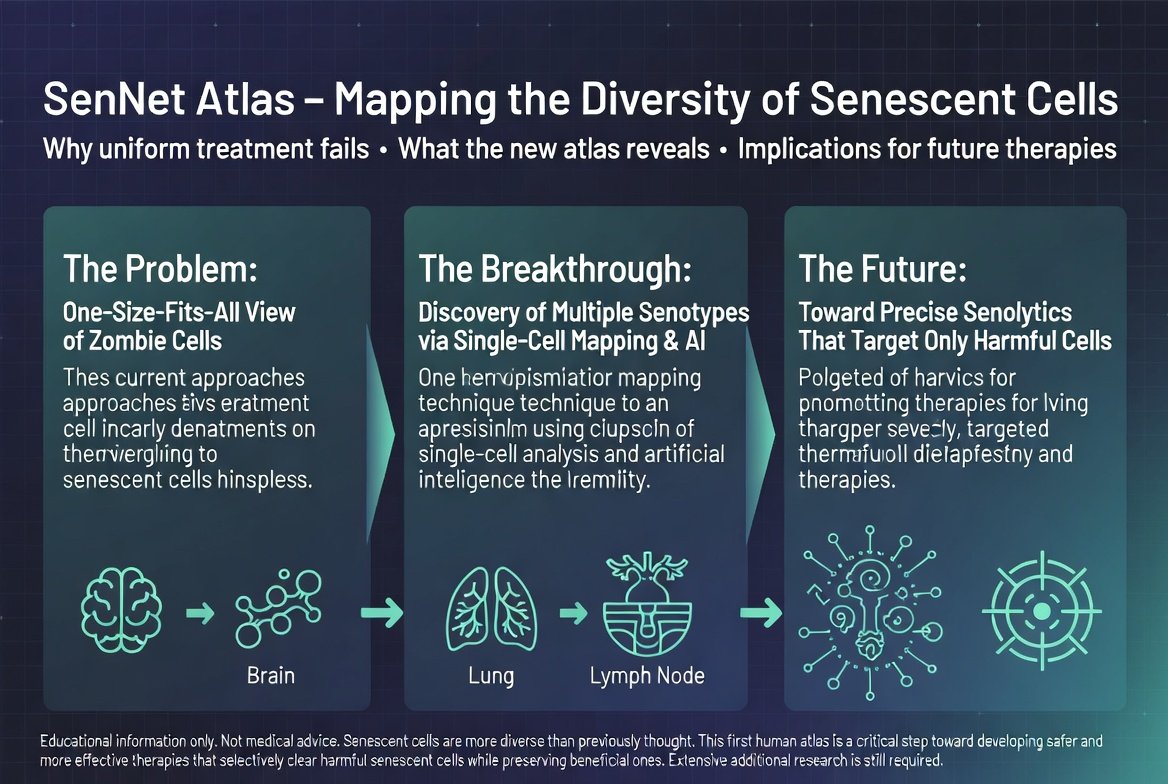
The Problem: Classic Senolytics Work Partially
The first senolytics (dasatinib + quercetin, navitoclax, fisetin) changed a lot. In mice, they showed dramatic improvement. But in clinical trials in humans, results are mixed:
- Moderate effect in some patients
- Small or no effect in others
- Significant side effects with navitoclax (affects platelets)
The reason: Most senolytics act on anti-apoptotic pathways, and different zombie cells have different dependencies. One senolytic does not fit all.
The New Approach: Ferroptosis Instead of Apoptosis
Apoptosis and ferroptosis are two types of cell death. They work differently:
Apoptosis
Classic "programmed death." The cell receives a signal, activates a cascade of enzymes (caspases), undergoes orderly collapse, and is cleared by immune cells. This is the standard process targeted by most senolytics.
Ferroptosis
A relatively new type of cell death first defined and described in 2012 (Dixon and colleagues). It relies on:
- High iron levels in the cell
- Oxidation of polyunsaturated fatty acids in the cell
- Accumulation of toxic lipid radicals (iron-dependent lipid peroxidation)
The cell does not receive a classic internal signal. It collapses because its membranes become oxidized and toxic from within.
Why Is This Relevant to Zombie Cells?
The team investigated this. They found that zombie cells have special characteristics that make them particularly sensitive to ferroptosis:
- High iron levels: Zombie cells accumulate internal iron. This iron primes them for ferroptotic death
- Many cytosolic polyunsaturated fatty acids (PUFAs): These fatty acids are susceptible to oxidation
- High baseline oxidative stress: High levels of ROS (Reactive Oxygen Species)
In other words: Zombie cells are a ferroptosis bomb waiting to explode. They just need a trigger.
The Discovery: Specific PUFAs Are the Trigger
The team conducted a phenotypic drug screen based on zombie cells and tested many fatty acids. α-eleostearic acid and its methyl ester derivative were identified as the most effective. They occur naturally in some sources (like Tung oil), but not at concentrations that produce a senolytic effect in a normal diet.
At pharmacological concentrations, these fatty acids:
- Entered the cell and its membranes
- Fueled a process of iron-dependent lipid peroxidation
- Created toxic lipid radicals
- Damaged cell membranes
- Caused the zombie cell to collapse via ferroptosis
Most importantly: this was selective. Zombie cells died, while healthy cells survived better. Why? Because healthy cells have less internal iron and fewer available sensitive PUFAs for oxidation.
Results in Mice
The researchers tested the fatty acids in mouse models, including accelerated aging mice (progeria, Ercc1 model). What was reported:
- Decrease in senescence markers (like p16 and p21) and SASP factors, notably in kidney, liver, and lung tissues
- Improvement in the composite health score in progeria mice, including relief from aging symptoms like tremors and spinal curvature (kyphosis)
- Extension of healthspan in mice
- No body weight loss and no notable side effects in the tested range
It is important to emphasize: these are qualitative results in mouse models, not precise percentage numbers and not in humans.
"This is the first paper showing that lipids can function as senolytics by activating a distinct form of cell death, called ferroptosis, unlike most existing senolytic strategies" - Prof. Paul Robbins, University of Minnesota.
Advantages of the Approach
1. High Selectivity
Ferroptosis requires a combination of iron + PUFA + ROS. Zombie cells are enriched in all three components. This may translate to high selectivity and minimal side effects, though this still needs validation in humans.
2. Different Mechanism from Classic Senolytics
Many zombie cells depend on different anti-apoptotic pathways, so one senolytic does not fit all. Ferroptosis attacks a completely different vulnerability—iron-dependent lipid peroxidation—and can therefore complement existing approaches.
3. Research Potential Beyond Senescence
Ferroptosis is also studied in other contexts in cell biology. Understanding how to target it selectively may be relevant to other research fields in the future.
4. Possible Oral Approach
Fatty acids can be taken orally and are absorbed in the gut. This may make development more convenient, though this still needs proof in humans.
Disadvantages and Challenges
1. Required Concentrations
α-eleostearic acid is not found in high concentrations in a normal diet. To achieve a senolytic effect, a concentrated pharmacological dose is needed, not food consumption.
2. Stability
Polyunsaturated fatty acids themselves oxidize. Stable formulations need to be developed.
3. Possible Interactions
Since the mechanism depends on iron and oxidation, there may be interactions with iron levels and antioxidants. The need for balance has not yet been studied in humans.
4. Unknown Long-Term Side Effects
Only studied in mouse models. Humans will require dedicated studies and long-term follow-up.
Next Steps
This is early research in mouse models. The natural next step in such research is developing a stable formulation and subsequently testing safety and efficacy. The researchers mention future clinical evaluation as a general goal, but no timeline for clinical trials has been published, and no precise dates should be inferred.
What Can Be Done Now?
α-eleostearic acid is not available as an approved and established supplement on the market, and the findings are only in mice. However, maintaining healthy mechanisms related to fatty acids and metabolism remains sensible:
1. Adequate Omega-3 Intake
Omega-3s (EPA, DHA) are important PUFAs for general health. Note: the specific link to ferroptosis in zombie cells has not been proven for them in humans.
2. α-Linolenic Acid (ALA)
Found in flaxseeds and walnuts. It is also a plant-based PUFA.
3. Physical Activity
Physical activity is linked to metabolic health and cellular clearance mechanisms, and is considered one of the most established interventions for healthy longevity.
4. Caution with High Doses of Antioxidants
High doses of vitamin E and N-acetylcysteine supplements could theoretically reduce lipid peroxidation. In any case, high supplement doses should be coordinated with a professional.
Broader Implications
The research expands the way we think about senolytics:
- Not just anti-apoptotic protein blockers
- Also activating cell death via iron-dependent lipid peroxidation (ferroptosis)
- Future possibility of combining several different senolytic approaches
- Aiming for more selective drugs with fewer side effects
The Bottom Line
Classic senolytics have shown promise but also limitations. The new approach of ferroptosis via specific PUFAs, led by α-eleostearic acid, opens a new research horizon—for now only in mice. If follow-up studies confirm safety and efficacy in humans, we may in the future have a selective senolytic with a different mechanism. Until then, a healthy lifestyle is the established way to support those same mechanisms.



💬 Comments (0)
Be the first to comment on the article.