For 100 years, we have tried to understand why we age. Dozens of theories have offered answers. The free radical theory. The telomere theory. The epigenetic theory. Each provides one piece of the puzzle. Now, a Research Perspective published in Aging-US proposes a unifying framework: a decline in ATP production through glycolysis may be a fundamental factor limiting lifespan. It is important to clarify upfront: this is a theoretical hypothesis synthesizing existing literature, not a new experimental study. The authors themselves explicitly state that it still needs to be tested in further studies. However, if the direction is correct, it could change the way we think about aging.
Introduction: How the Cell Produces Energy
Every cell in your body needs ATP, the "energy currency" of the cell. There are two main pathways for its production:
Glycolysis
An ancient pathway (general, evolutionary background: it developed before mitochondria), simple, and very fast. Glucose is broken down into 2 pyruvate molecules, producing only 2 ATP molecules per glucose molecule. It takes place in the cytoplasm and does not require mitochondria. Its main advantage, according to the paper, is speed.
Oxidative Phosphorylation
A pathway that takes place in the mitochondria. Pyruvate enters the mitochondria and undergoes the Krebs cycle and the electron transport chain. It produces about 30 ATP or more from the same glucose molecule (a general biochemical fact), meaning it is much more efficient in terms of energy quantity. (Note: comparing the quantities 2 vs. 30+ is standard biochemical background, not a unique claim of the paper.)
It would be logical to think the cell would always prefer the efficient one. So why not rely solely on oxidative phosphorylation? This is where the hypothesis comes in.
The Core Idea: Speed, Not Just Efficiency
The paper suggests that energy efficiency alone is not everything. While oxidative phosphorylation produces more ATP, glycolysis provides ATP much faster (the paper notes that glycolysis can supply ATP at a significantly faster rate than oxidative phosphorylation). The speed of energy supply is particularly important for cells that need readily available, immediate energy:
- Rapidly dividing cells: Stem cells, immune cells, and other cells that require available energy for division and repair
- Repair processes: DNA repair and cellular maintenance that require fast ATP
The paper's hypothesis: With age, glycolytic ATP production declines. And when it declines, cells that depend on fast energy struggle to function. The central hypothesis in the paper emphasizes the rate of decline: according to the authors, evolutionarily successful species are those in which the rate of decline in glycolytic ATP production over time was optimal.
The Cancer Cell as a Counter-Example
The paper points to cancer cells ("immortal" cells) as an illustration of the idea. These cells remain highly glycolytic even in the presence of oxygen, a phenomenon known as the "Warburg effect." According to the paper, they are characterized by very active glycolytic ATP production and activation of the transcription factor HIF-1α even under high oxygen conditions, and the oncogene c-Myc increases glycolytic flux. In other words: when cells maintain high glycolysis, their division capacity is preserved (for good, in healthy cells, and for bad, in cancer).
The Naked Mole Rat: A Supporting Example
The naked mole rat lives for about 30 years or more, far beyond what is expected for a mammal its size. The paper cites it as a supporting example: according to the authors, it maintains high glycolytic flux and glycolytic ATP supply, an adaptation to subterranean life with low oxygen levels.
An important point for accuracy: The finding that the naked mole rat can rely on glycolysis even under anoxic conditions originates from a separate study (Park et al., Science 2017), not from the current Research Perspective. The Research Perspective incorporates this insight into its theoretical framework. The statement that its cells "produce ATP at a youthful rate even at age 25" that appeared in a previous version is unfounded and has been removed.
The Elephant vs. The Mouse
The paper also uses a cross-species comparison as an illustration: elephants live tens of times longer (as phrased in the paper, an elephant lives about 30 times longer than a mouse), despite being much larger. The paper suggests that differences in the rate and manner in which species manage glycolytic ATP production over their lifespan may be linked to lifespan. (Note to readers: this is a conceptual illustration of the hypothesis, not experimental data from this paper.)
How Does Glycolysis Integrate with Other Aging Pathways?
The beauty of this theoretical framework is that it conceptually links different phenomena already known in aging. The general idea: cellular maintenance and repair processes require readily available, fast ATP, so a decline in glycolytic ATP production may impair them. This includes:
- DNA repair and maintenance: Processes that require available energy
- Mitochondrial maintenance and cellular cleanup: Energy-intensive processes
- Immune system function: Immune cells rely heavily on immediate energy for division and response
It is important to remember that these are conceptual links within the hypothesis, not causal proof provided by the paper through experimentation.
Possible Implications (Speculative)
If the direction of the hypothesis is correct, one could speculate that interventions that preserve healthy cellular metabolism might be relevant. It is worth emphasizing: these are speculative implications derived from the idea, not experiment-based recommendations from the paper.
- Physical activity: Exercise, including intense training, requires the cell to have available energy. Maintaining metabolic fitness is among the most established interventions for health throughout life.
- Caloric restriction and intermittent fasting: Their effects on metabolism are widely studied; evidence is stronger in model animals, and encouraging but more limited in humans.
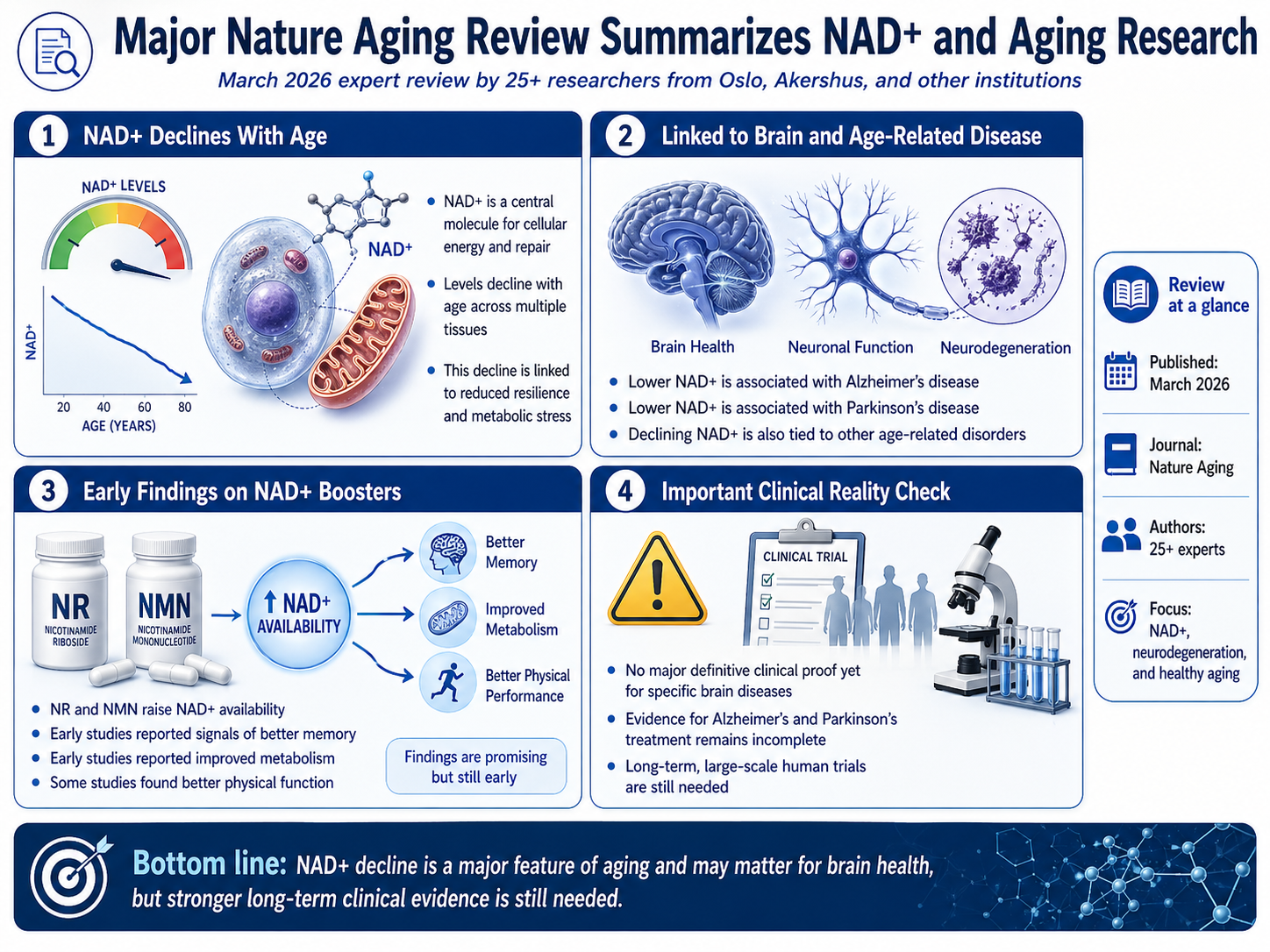
- NAD+ and its precursors (NMN, NR): NAD+ is a central coenzyme in energy metabolism, and its levels decline with age. NAD+ boosters show modest effects in humans, not the drastic results implied in marketing.
Currently, as of the paper's publication, there is no dedicated and validated drug pipeline aimed at increasing glycolytic ATP production to treat aging. Any claim about "drugs coming soon" with a precise timeline is unfounded.
Caution: This is a Hypothesis, Not Proof
This is the most important point in this article. The authors themselves explicitly state that this is a hypothesis that needs to be tested. In the paper's language: the validity of the hypothesis should be examined in further studies in vivo and in vitro through regulation of glycolysis. That is:
- There is no new experiment conducted by the authors here
- The idea synthesizes existing knowledge and proposes a unifying framework
- Direct experiments, in animal models and cells, are required to confirm or refute it
The Bottom Line
Theories of aging evolve. This Research Perspective in Aging-US offers a metabolic angle: that perhaps preserving the cell's ability to produce energy quickly, through glycolysis, is a common thread linking many aging phenomena. This is an interesting and unifying idea, but at this stage, it is a hypothesis awaiting experimental testing, not an established fact. If and when it is tested and confirmed, it may be seen years later as an important building block in understanding aging. Until then, the practical recommendations remain the same established ones: physical activity, good nutrition, and maintaining metabolic health.

💬 Comments (0)
Be the first to comment on the article.