For an entire decade, cellular rejuvenation was a promise living in laboratories: old mice that became young, human cells reset in a petri dish, and headlines shouting "revolution." On June 9, 2026, something changed. The first anti-aging drug explicitly designed to reset the biological age of human cells left the lab and was injected, for the first time ever, into the body of a living human.
The company is Life Biosciences from Boston, founded on the research of Professor David Sinclair from Harvard Medical School. The drug is called ER-100. But before getting too excited, it is important to understand exactly what happened here, and equally, what has not happened yet. This is precisely where our voice of truth comes in.
What is ER-100?
ER-100 is not a pill or an intravenous injection. It is a gene therapy injected directly into the eye (intravitreal injection). Here is what it does, in simple points:
- Viral delivery: An AAV vector (a harmless virus used as a "messenger") carries new genetic instructions into retinal cells.
- Three Yamanaka factors: The instructions tell the cell to produce three proteins, OCT4, SOX2, and KLF4, collectively known as OSK.
- Without the dangerous gene: The original fourth factor, c-Myc, was intentionally omitted. It is the factor associated with cancer risk.
- Built-in off switch: The genes are active only when the patient takes the antibiotic doxycycline. As soon as the drug clears the body, the genes turn off.
In other words, ER-100 does not change the DNA itself. It changes the epigenetics: the layer of "notes" above the genes that determines which genes are on and which are off. With age, this layer of notes becomes disorganized, and cells "forget" how to function like young cells. The idea of OSK is to restore the notes to their youthful state.
Partial Reprogramming: The Mechanism Without the Hype
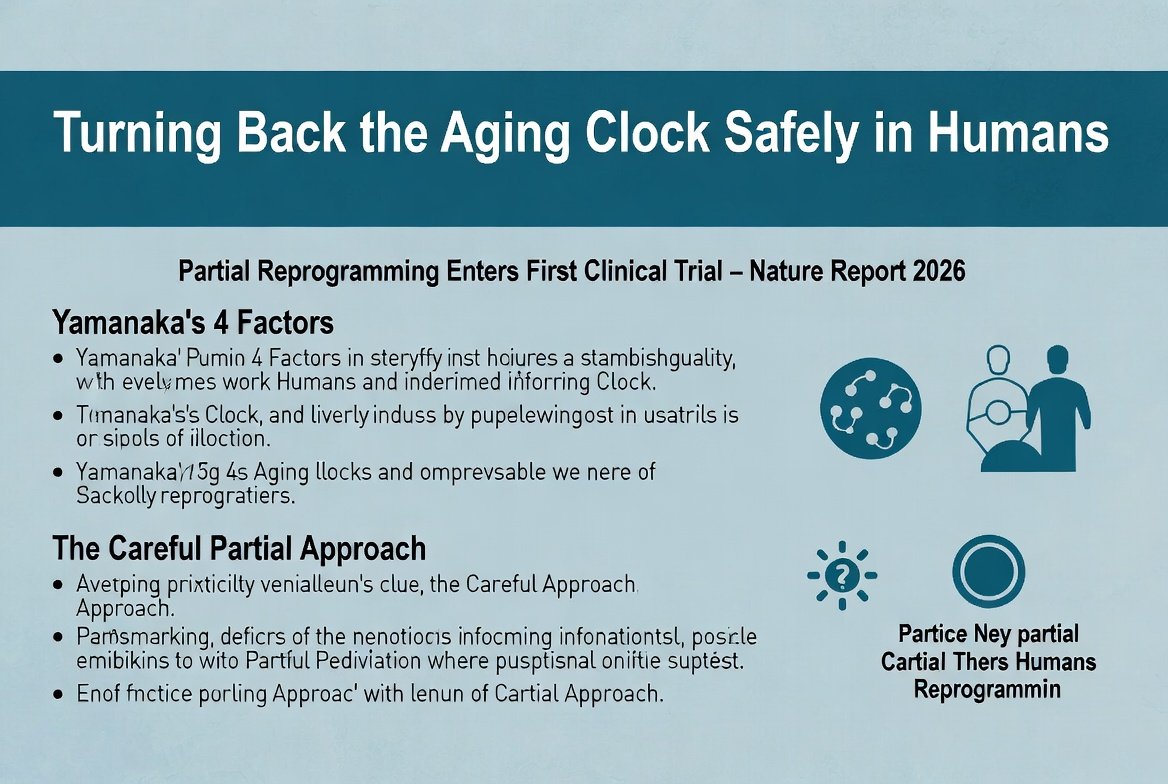
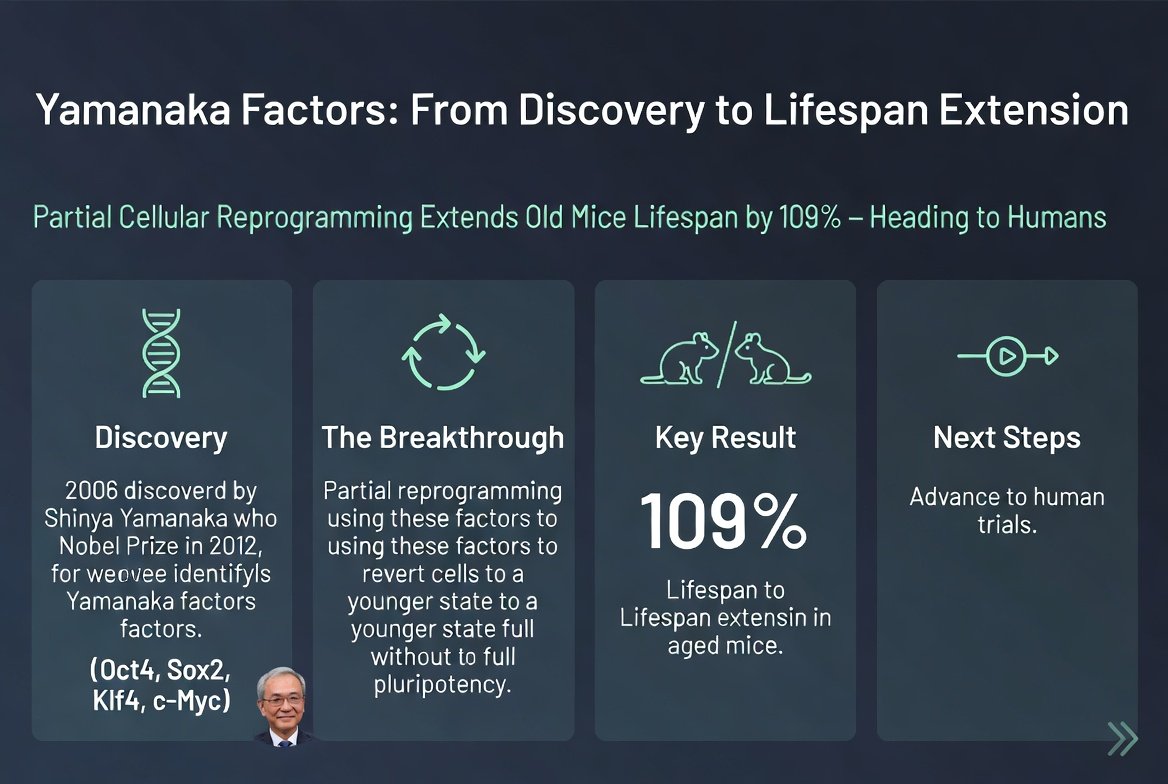
To understand why this is so exciting, we need to go back to 2006. Japanese researcher Shinya Yamanaka discovered that just 4 genes could revert a fully mature cell back to an embryonic stem cell state. The discovery earned him the Nobel Prize in 2012. But there was a problem: the process took the cell all the way back, erased its identity, and turned it into a stem cell. A skin cell became a stem cell, not a young skin cell.
Partial reprogramming is the solution: the factors are activated only for a limited time, and then stopped, before the cell loses its identity. The result, at least in mice, was remarkable: the cell remained an eye cell or a nerve cell, but its epigenetic clock was turned back. Aging markers disappeared, and function improved. This is how we distinguish between "partial reset" and "full deletion."
We have elaborated on this mechanism in a separate article, and if you want the full explanation of how Nobel Prize-winning genes can reverse aging, it is worth reading alongside this article.
The Evidence That Led to This Point
The human trial did not appear out of nowhere. It is based on a series of studies, each adding a layer.
Study 1: Vision Restoration in Mice, Nature 2020
This is the study that ignited the entire chain. A team in Sinclair's lab at Harvard, led by researcher Yuancheng Lu, injected the three OSK factors into retinal ganglion cells in mice. The results, published in the journal Nature and featured on its cover: the cells restored young methylation patterns (epigenetic marks), nerve fibers regrew after injury, and vision was restored in a mouse model of glaucoma and in old mice. This was proof that partial reprogramming could not only stop damage but reverse it.
Study 2: Transition to Primates
Before injecting into humans, the FDA requires proof of safety and efficacy in larger animals. Life Biosciences tested ER-100 in a monkey model of optic neuropathy (NAION). The treatment restored epigenetic information and improved electrical conduction in the optic nerve, without the severe side effects that were feared. This success opened the door for FDA approval.
Study 3: FDA Approval and the First Patient
In January 2026, the FDA granted an IND (Investigational New Drug) approval to Life Biosciences to begin a Phase 1 human trial. On June 9, 2026, the company announced that the first patient had received a dose. Trial size: up to 18 patients only, with open-angle glaucoma and NAION (a type of "eye stroke" causing sudden vision loss, mainly in adults over 50). Follow-up duration: up to 5 years.
What About Other Organs: Heart, Brain, Skin?
Why the eye specifically? Because it is an ideal target for a first trial: it is accessible, relatively isolated from the rest of the body (so if something goes wrong, the damage is contained), and relatively easy to measure outcomes. But the potential is much greater. If the approach proves safe and effective, the same principle of partial reprogramming could in the future be tested in the heart (after a heart attack), muscle (sarcopenia), liver, and even the brain (Parkinson's, Alzheimer's). The eye is the tip of the iceberg, and intentionally so.
Is This Really a Youth Drug?
And here we need to pump the brakes. This is the point that distinguishes responsible reporting from an inflated headline. Despite the media frenzy, here is what this trial is not:
- It is not an efficacy trial, it is a safety trial. The primary goal of Phase 1 is to test that the treatment is not dangerous, not to prove it works. Even if everything goes perfectly, we will only know it is safe enough to move to Phase 2 and 3.
- It is not a general anti-aging treatment. It is aimed at a specific eye disease. No one is injecting themselves with OSK to "rejuvenate." This is a defined medical indication.
- The risks are real. Overly aggressive reprogramming could cause cells to lose their identity or, in the worst-case scenario, form tumors (teratoma). The doxycycline switch is designed precisely to minimize this risk, but it is still a theoretical risk.
- The timeline is long. Even in the optimistic scenario, many years will pass before such a treatment is available, even just for eye diseases, let alone broader use.
The scientific community is excited, and rightly so. But cautious professionals emphasize that this is the first step of a long journey, not the finish line.
What to Take Away from This Research?
- If you are interested in the trial itself: It is registered on ClinicalTrials.gov and is intended solely for patients with glaucoma and NAION. Do not look to "buy" the treatment; it is experimental, not commercially available, and there is no legal or safe way to obtain OSK.
- If you are healthy: The most powerful thing you can do now is keep your epigenetic clock as "young" as possible through proven methods: quality sleep, physical activity, a good diet, and avoiding damage that is hard to repair (smoking, excessive sun exposure, chronic stress).
- If you have an eye disease: Talk to an ophthalmologist about existing and proven treatments. ER-100 is years away from being an option.
- If you want to stay updated: It is worth following the results of Phase 1, expected later, as they will teach us whether humans, not just mice and monkeys, can tolerate partial reprogramming.
The Broader Perspective
This injection is a real milestone, but it is also a reminder of a principle we return to again and again: between proof of mechanism and a drug that works and is safe in humans, there is a long road, full of obstacles. Thousands of treatments have looked promising in mice and failed in humans. Partial reprogramming is perhaps the most powerful approach we have ever identified for reversing aging, and precisely because of that, it deserves to be analyzed with open eyes, not starry eyes.
The first time a human received such a treatment will be remembered in history. But history will be written not at the moment of injection, but in the years to come, when we know if it is truly safe, and then, if it truly works.
References:
Lu et al., Reprogramming to recover youthful epigenetic information and restore vision, Nature 2020
Life Biosciences, ER-100 and Optic Neuropathies
ClinicalTrials.gov, NCT07290244

💬 Comments (0)
Be the first to comment on the article.