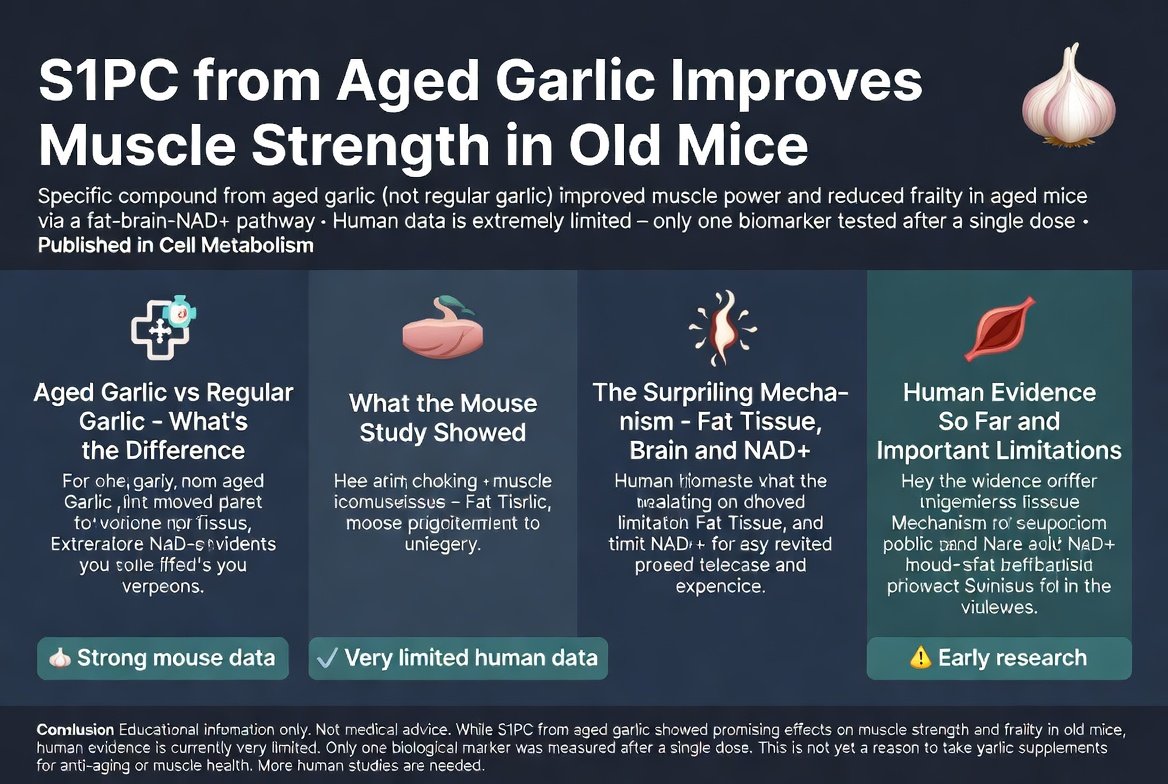
There was a time when anti-aging drugs were sought only in complex molecules, peptides, and sophisticated genetic engineering methods. But often, development began with mold on rice (statins, rapamycin) or research on traditional foods. A new study published in the prestigious journal Cell Metabolism points to a surprising candidate: a compound concentrated in aged garlic, which appears capable of improving muscle function in aging, through a surprising communication pathway between fat tissue and the brain.
The Story of S1PC
Garlic contains hundreds of compounds, but the researchers, a Japanese-American team led by researchers from Wakunaga, the National Center for Geriatrics and Gerontology in Japan, and the University of Washington, identified one specific compound as key: S-1-propenyl-L-cysteine (abbreviated as S1PC), a sulfur amino acid particularly concentrated in aged garlic extract.
This is an important point: it is not a compound released from cutting fresh garlic, but a compound formed and accumulated during the long aging process of garlic, which lasts months. Therefore, the practical context here is aged garlic extract and standardized supplements, not just a clove of garlic from the refrigerator.
What Does S1PC Do to Muscles?
This is the truly interesting part. Contrary to what one might think, S1PC does not act directly on muscle cells. Instead, the researchers uncovered an inter-organ communication axis: Fat ↔ Brain ↔ Muscle.
The team examined older mice and found that prolonged administration of S1PC led to:
- Increased muscle strength (force), meaning an improvement in muscle function.
- Decreased frailty indices in the older animals.
- Restoration of core body temperature, another marker of metabolic health in aging.
A critical point to be precise about: the study found an improvement in muscle function and strength, and did not report an increase in muscle mass. That is, the contribution is to the quality and strength of the muscle, not necessarily to the amount of tissue. This is an important distinction because strength and function are what determine independence and prevent falls in old age, sometimes even more than mass itself.
How Does It Work? The NAD Pathway from Fat to Brain
This is the central mechanism the study cracked, and it is sophisticated:
- Step 1: S1PC activates an enzyme called LKB1 (Liver Kinase B1) in white adipose tissue, by enhancing its ability to form a complex with the proteins STRAD and MO25.
- Step 2: Activated LKB1 leads to phosphorylation of SIRT1, a protein well-known in aging research (an NAD-dependent sirtuin).
- Step 3: This promotes the secretion of an enzyme called eNAMPT from fat tissue. eNAMPT is a key component in the production of NAD+, a molecule essential for cellular energy and health.
- Step 4: The eNAMPT secreted from fat travels in the bloodstream and specifically targets the hypothalamus, a central control center in the brain, and from there a signal is sent (via the sympathetic nervous system) that improves muscle function.
In other words: it's not that "garlic strengthens the muscle" directly. Rather, a compound in garlic talks to fat tissue, which talks to the brain, which talks to the muscle. A complete fat-brain-muscle axis.
And Humans? The Small Human Trial
Beyond mice, the study also included a preliminary human component: subjects were given a single human dose of S1PC. The result: an increase in eNAMPT levels in the blood, especially in people with normal and healthy fat mass.
This is an encouraging finding because it shows that the pathway identified in mice is also relevant in humans. But it's important to keep perspective: it was a single dose, in a small number of subjects, and measured a biomarker (eNAMPT), not a measurable improvement in muscle strength in the elderly. The researchers themselves note that the next step is to test whether the increase in eNAMPT indeed translates to improved muscle strength and frailty in older adults.
So What Do You Do With This in the Kitchen?
Here caution is needed, because it's easy to jump to early conclusions. A few important points:
This is Not the Magic of Fresh Chopped Garlic
The compound studied, S1PC, is concentrated in aged garlic, not in fresh garlic you just cut. The "chop, wait, cook" rule circulating online relates to a completely different compound (allicin) and is not relevant to S1PC. If you want this specific compound, the context is aged garlic extract or a standardized supplement, not a clove from the refrigerator.
This is Early Research, Mostly on Mice
Most of the data is from mice, and the human component is preliminary (single dose, blood marker). There is no established recommended dosage for humans yet, and no clinical proof that aged garlic prevents sarcopenia in people. This is an interesting scientific promise at an early stage, not a therapeutic recommendation.
Garlic, in General, is a Healthy Food
Even without the magic of S1PC, garlic is part of a healthy Mediterranean diet. There is no reason to avoid it, but there is currently no scientific basis to consume aged garlic in excessive amounts to "save your muscles."
Caution
Garlic and garlic extracts in high amounts are not without side effects:
- Blood-thinning effect; if you take Coumadin/aspirin, consult a doctor.
- Gastrointestinal irritation in some people.
- Possible interaction with certain medications (including HIV medications); it's important to know if relevant.
The Summary
In a world full of expensive supplements promising to make you 30 again, there is something refreshing about a compound derived from garlic, a food that has accompanied humanity for thousands of years, being seriously studied as a pathway for maintaining muscle strength in aging. The study in Cell Metabolism revealed an elegant communication axis between fat, brain, and muscle, based on NAD, and activated by the compound S1PC from aged garlic.
But let's maintain scientific integrity: this is early research, mostly in mice, with only a preliminary human component, and it showed an improvement in muscle strength and function, not an increase in muscle mass. It is not a solution for sarcopenia. The core for maintaining muscle remains the same: a high-protein diet, resistance training, and vitamin D (see our article on sarcopenia). S1PC is an intriguing research direction worth following, not a prescription.
References:
Cell Metabolism (2026) - Garlic-derived metabolite activates LKB1, promotes adipose eNAMPT secretion, and improves age-related muscle function via hypothalamic signaling
Sci.News - Garlic Compound May Hold Clue to Slowing Muscle Aging


💬 Comments (0)
Be the first to comment on the article.