In recent years, the study of aging has focused mainly on what we eat, how we exercise, and how much we sleep. The physical environment—the air, noise, and surrounding chemicals—was treated as a backdrop. That was a mistake. Environmental-neurological research from recent years paints a completely different picture: the environment is not a backdrop; it is an active player in the rate at which our brain ages.
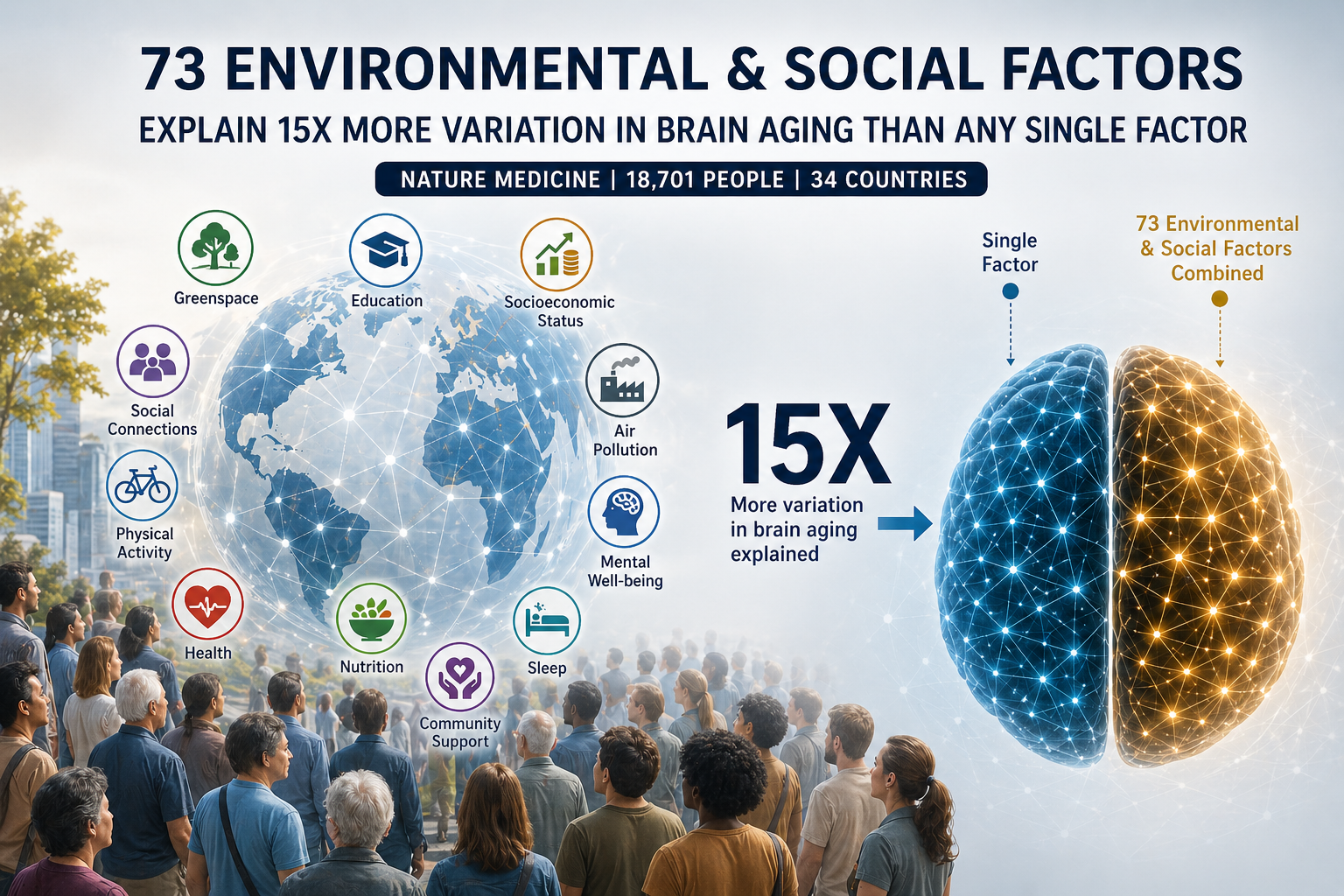
In July 2025, a large-scale international study led by the Global Brain Health Institute, along with partners worldwide, was published in the prestigious journal Nature Medicine. The study analyzed data from approximately 161,981 people across 40 countries, seeking the link between cumulative environmental exposure (the Exposome) and the rate of biobehavioral aging. The key finding: the combination of environmental factors together explained the variance in brain and body aging much better—about 15 times better—than any single factor. Environmental pollution and brain aging are closely, measurably, and modifiably linked.
This does not leave us helpless. On the contrary, this understanding opens the door to personal and policy interventions that can add years of healthy cognitive function.
Which pollutants are we talking about?
The researchers identified five main groups of environmental exposures with a proven impact on the brain:
- Fine particulate matter (PM2.5): Particles with a diameter of 2.5 microns or less, originating mainly from diesel engines, power plants, wildfires, and home cooking. They are small enough to enter the bloodstream through the lungs and reach the brain via the olfactory nerve.
- Chronic environmental noise: Traffic noise, aircraft noise, industrial noise. From an average day-night level of 55 decibels, an increase in blood pressure, sleep quality issues, and markers of brain aging are observed.
- Lead and heavy metals: Lead accumulated in childhood (from leaded gasoline until the 1990s, old water pipes, old wall paint) remains in bones for decades and is slowly released.
- Microplastics and nanoplastics: Plastic particles with a diameter below 5 mm down to less than 1 micron. Found in water, air, food, and recently also inside human brain tissue.
- Urban heat islands: Chronically high temperatures in concrete and asphalt concentrations. Accumulated heat affects sleep, systemic inflammation, and blood supply to the brain.
As of the beginning of this decade, about 99% of the world's population lives in areas where air quality does not meet World Health Organization recommendations. This is not someone else's problem. It is us.
The link to environmental pollution and brain aging: biological mechanisms
How exactly does a pollution particle turn into brain damage? There are at least four parallel pathways:
1. Direct entry via the olfactory nerve. PM2.5, and especially the smaller version PM0.1 (ultrafine), penetrate the epithelium in the nasal cavity and travel through olfactory receptor cells to the Olfactory Bulb. From there, they spread to other brain areas. Autopsy tests have found magnetite nanoparticles (a high-temperature combustion product, such as from diesel engines) in the brain tissue of residents of Mexico City and Manchester, exactly the type emitted by transportation. This magnetite is chemically active and is suspected of being involved in neurodegenerative diseases.
2. Systemic neuroinflammation. When particles enter the bloodstream through the lungs, they activate white blood cells that secrete inflammatory cytokines (TNF-alpha, IL-6). Part of this inflammation reaches the brain through the blood-brain barrier. Chronic background brain inflammation is one of the key drivers of neural aging in general.
3. Oxidative stress in the endothelium. Pollutants damage the endothelial cells of small blood vessels in the brain. Blood flow becomes inefficient, microvascular white matter lesions form, and the blood-brain barrier becomes more leaky. This leakage allows additional neurotoxic substances to enter.
4. Noise as a chronic stressor. Nighttime noise activates the HPA axis even when we do not wake up. Chronically elevated cortisol damages the hippocampus, an area involved in memory. Traffic noise has also been shown to raise blood pressure, which accelerates white matter lesions.
These four pathways operate in parallel, and the effect is usually cumulative rather than immediate. This is why it was difficult to identify the link for decades: it spans 20-40 years of exposure.
Current evidence
Study 1: The Exposome and aging, Nature Medicine 2025
The study at the center of the discussion. An analysis of approximately 161,981 people from 40 countries, including Egypt, South Africa, Latin American and Caribbean countries, Europe, and North America. The researchers used a measure called the Biobehavioral Age Gap, i.e., the difference between the estimated age based on risk and protective factors and the actual chronological age. The finding: total environmental exposures—from air pollution and heat peaks to structural inequality and political instability—explained the variance in accelerated aging much better than any single factor, about 15 times better. Accelerated aging was particularly observed in populations in Egypt, South Africa, and parts of Latin America and the Caribbean, while an enriching environment, cognitive stimulation, and social cohesion were linked to slower aging.
Study 2: Meta-analysis in Lancet Planetary Health, 2025
A meta-analysis led by the MRC Epidemiology Unit at the University of Cambridge, published in July 2025. The researchers reviewed dozens of studies (51 studies in the systematic review, and up to about 29 million participants in the included data), most from developed countries. For every increase of 10 micrograms per cubic meter in PM2.5, the relative risk of dementia increased by about 17%. Additionally, for every increase of 10 micrograms per cubic meter in NO2 (nitrogen dioxide), the risk increased by about 3%, and for every increase of 1 microgram in Black Carbon, the risk increased by about 13%. Air pollution is one of the modifiable risk factors for dementia, and every reduction in air quality counts.
Study 3: Traffic noise and dementia, Denmark, BMJ 2021
A national cohort study of approximately 1.94 million Danish residents aged 60 and over, between 2004 and 2017, which analyzed traffic noise levels based on residential addresses. Exposure to high traffic noise was linked to an increase of up to about 27% in the risk of Alzheimer's and an increase of about 18% in the risk of all-cause dementia, even after adjusting for air pollution. It is important to be precise: this was a registry study based on diagnoses and a noise model by address, and did not include MRI imaging or hippocampal volume measurement. However, the result added to the evidence that chronic noise, not just the accompanying air pollution, itself contributes to damage.
Study 4: Microplastics in human brain tissue, Nature Medicine
A study by researchers at the University of New Mexico (UNM) examined brain tissue (frontal cortex) from 52 deceased individuals, comparing samples from 2016 to samples from 2024. The concentration of micro and nanoplastics in brains from 2024 was about 50% higher than in 2016, a clear increase over time. In samples from individuals diagnosed with dementia, the concentration was significantly higher, by several times (about 3 to 5 times), compared to individuals without dementia. The researchers also found much higher plastic concentrations in the brain than in the liver and kidneys. The link has not yet been proven causal, and it is possible that the dementia process itself increases accumulation, but the finding has stirred the scientific community.
What about heart disease, diabetes, and lung health?
The environmental story does not end with the brain. The same pollutants that accelerate brain aging also accelerate heart disease, type 2 diabetes, COPD, and even lung cancer. PM2.5 has been recognized by the IARC (the WHO's International Agency for Research on Cancer) as a Group 1 carcinogen, alongside smoking and radiation. Daily exposure to poor urban air is equivalent, in terms of excess mortality, to smoking several cigarettes a day, even if the individual does not smoke.
The concept of the Exposome, the totality of environmental exposures over a lifetime, is becoming central in aging research. The genome determines potential; the Exposome determines realization. A person with excellent genes who grew up next to a busy road and with lead in the pipes will age faster than a person with average genes who grew up in clean air.
This is why endocrinologists, cardiologists, and neurologists are increasingly interested in environmental medicine. The body is one, the exposure is one, the aging is one.
Does this mean I need to move to the countryside?
No, and most people cannot. But the research offers a full spectrum of protective actions, at both the individual and policy levels:
- The risk is not absolute. The risk increase spans 20-40 years of exposure. Any reduction, even partial, even after age 50 or 60, can slow the process.
- The brain is resilient. Two people with the same exposure show different outcomes because genetics, cognitive reserve, and lifestyle complement each other.
- Partial solutions work. Even a 20-30% reduction in exposure translates to a decrease in risk. You do not need to reach zero levels.
- It is not just personal. Policy decisions (public transportation, clean fuel, noise laws, pedestrian zones) are the most powerful tool. In this case, civic voice is also a health tool.
The call is not to move to a wooden house in the forest. The call is to stop ignoring exposure and start managing it like we manage diet.
What should we take from the research?
- Check the air quality where you live. Sites like IQAir, AirNow, and Aqicn display real-time PM2.5. If the annual average in your area is above 15 micrograms per cubic meter, you have a reason to act.
- Invest in a real HEPA filter. A quality HEPA filter in the bedroom and living space reduces indoor PM2.5 concentration by 50-80%. Initial cost 600-1500 NIS per device, filter replacement once a year. This is the cheapest investment in your brain.
- Avoid physical activity on a busy road during rush hour. Running next to a road increases PM2.5 intake by 5-10 times due to high breathing rate. Switch to a park, grove, or ventilated gym.
- If you live in a noisy city, invest in acoustic insulation for the bedroom. Quality windows, thick curtains, earplugs when needed. Nighttime noise is the most damaging, even if you do not consciously wake up from it.
- Check for lead in children. If your home was built before 1980, or you have old water pipes, check the lead level in children's blood. Childhood exposure affects decades later.
- Filtered water, not plastic bottles. Water from plastic bottles that have been in the sun contains more microplastics. A home activated carbon filter is a cheap solution for most problems, and sometimes it is worth considering Reverse Osmosis if you live in an area with lower quality water.
- Green vegetation and nearby trees. Green spaces in the city reduce local PM2.5, noise, and temperature. If you are choosing an apartment, an area with 200 meters of green space nearby is worth 5-10% higher rent.
- Contact your public representatives. Pedestrian zones, bans on old diesel, noise laws, water pipe quality: these are policy decisions. Voting and civic engagement are public health tools.
The broader perspective
The classic recommendations for healthy aging focused on four pillars: nutrition, movement, sleep, and mental rest. Current evidence adds a fifth pillar: environment. And not just as a supplement, but as an independent pillar, with an impact that rivals the other pillars.
You can eat broccoli, exercise five times a week, sleep 8 hours, and meditate every morning, but if you live next to an airport runway or spend two hours a day in traffic, some of those achievements will be erased. The environment is not a backdrop. It is a diet. Every breath, every sleep, every walk is a dose of life or a dose of poison.
The positive side: since it is continuous exposure, every continuous improvement also counts. A HEPA filter in the bedroom, a sealed window, a different running route, moving to a less busy street—all these accumulate. Our brain, like the entire body, responds to the environment. If we give it a better environment, even at a relatively late stage in life, it will repay with better function.
The bottom line: What is around you, enters you. What you choose to change around you, will also change you.
References:
The exposome of healthy and accelerated aging across 40 countries (Nature Medicine, 2025)
Long-term air pollution exposure and incident dementia: meta-analysis (Lancet Planetary Health, 2025)
Residential exposure to transportation noise and incidence of dementia (BMJ, 2021)
Bioaccumulation of microplastics in decedent human brains (Nature Medicine)
WHO - Ambient Air Quality and Health

💬 Comments (0)
Be the first to comment on the article.