Once every few years, a story explodes in the longevity field that isn't about a new molecule at all, but about the way it is sold. In May 2026, the site Nutrition Insight reported on a fascinating clash: Tru Niagen, one of the most branded supplements in the world for raising NAD+ levels, found itself facing U.S. advertising watchdogs. The name of the body that initiated the review? The National Advertising Division, whose initials, with complete irony, are exactly NAD.
This clash is not a technical legal dispute. It is a window into one of the biggest problems of the entire anti-aging industry: the vast gap between what marketers promise and what science has actually proven. In other words, this is not a story about the biochemistry of NAD+, we have already written about that mechanism. It is a story about consumer protection, about how to read marketing claims with a critical eye, and about why regulators around the world are starting to sniff around the longevity supplement field closely.
What is the Tru Niagen story actually about
Tru Niagen is a trade name for a supplement whose active ingredient is Nicotinamide Riboside (NR), a form of vitamin B3 intended to raise NAD+ levels in the body. To understand the clash, you need to know four players:
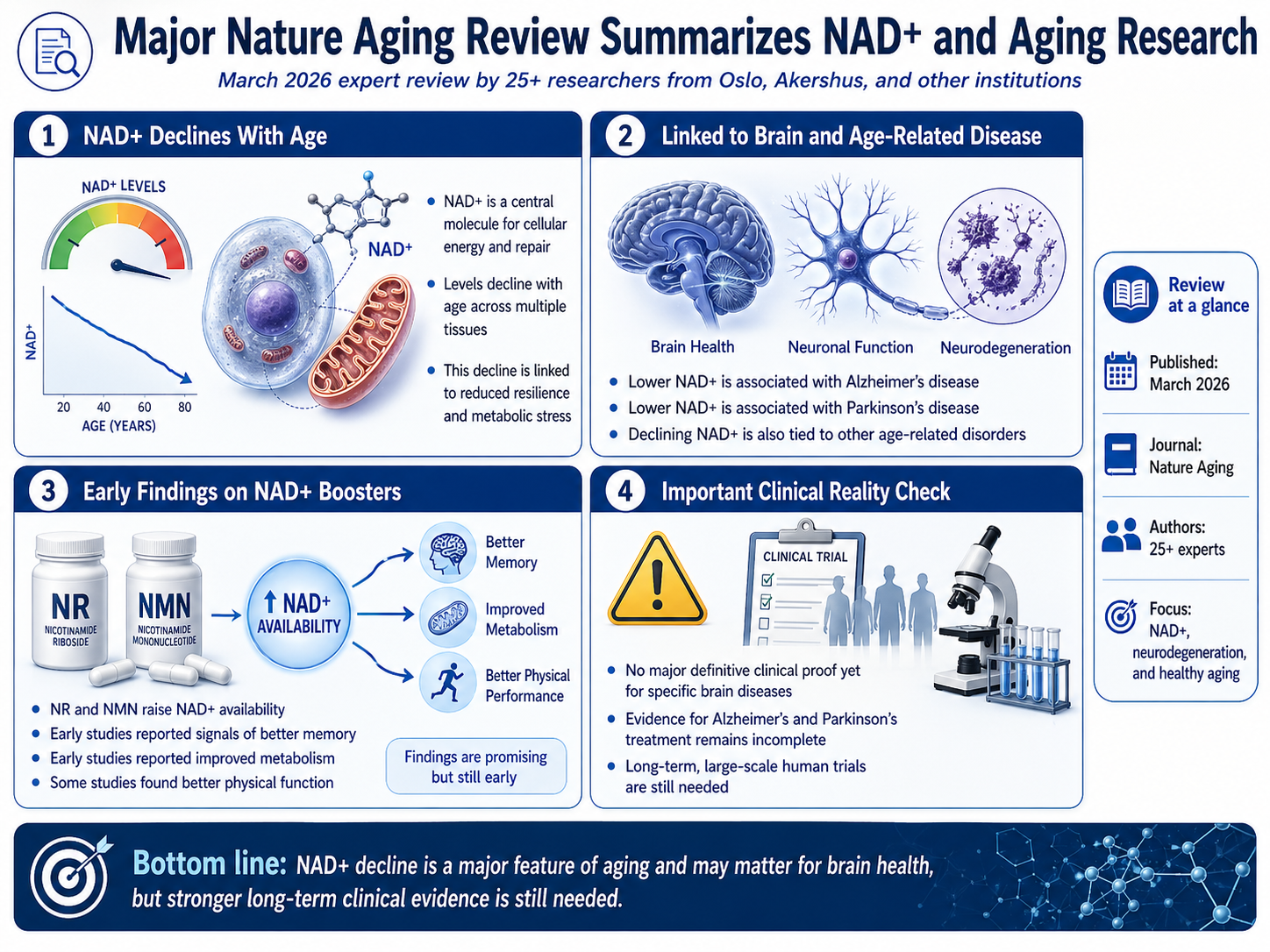
- NAD+, an essential coenzyme whose level in the body declines with age. The scientific basis for this entire category.
- NR (Nicotinamide Riboside), the active ingredient in Tru Niagen. One of several forms of NAD+ precursors (alongside NMN and niacin).
- Tru Niagen, the brand that markets NR to the end consumer under promises of energy, cellular health, and slowing aging.
- The National Advertising Division (NAD), the self-regulatory body of the U.S. advertising industry, whose role is to examine whether advertising claims are supported by evidence.
The core of the story: The advertising watchdog examined Tru Niagen's marketing claims and determined that some of them are not sufficiently supported by clinical evidence in humans. The claims under scrutiny were of the type 'boosts energy', 'supports cellular health', and especially the insinuations that the product slows aging itself.
What does the advertising watchdog actually do
The National Advertising Division is not the FDA. This is a critical point to understand. The FDA oversees safety and what is allowed to be sold, but dietary supplements in the U.S. are under a loose regulatory regime: they are considered safe until proven otherwise, and the manufacturer is not required to prove efficacy before selling.
This is where the NAD comes in. It is a self-regulatory body of the advertising industry, which examines one of the things the FDA barely touches: whether the advertising itself promises things that science does not support. When a competitor complains, or when the body initiates a review on its own, it demands that the advertiser present the evidence behind each claim. If the evidence is lacking, the recommendation is to modify or remove the claim.
In the case of Tru Niagen, the process unfolded in two stages, and it is worth knowing them. The review was opened following a complaint from a competitor named Reus Research LLC. In March 2026, the National Advertising Division published its initial recommendation: to modify or remove some of the claims, including the claim that the product is 'clinically proven' to raise NAD+ and the link between raising NAD+ and a host of health benefits. The company appealed the decision, and the appeal went to the appeals body, the National Advertising Review Board (NARB). On May 21, 2026, the NARB published its decision, in which it affirmed the NAD's position and recommended the company modify or cease certain claims regarding NAD+ (among others, claims concerning heart, brain, and immune health, and slowing aging and energy). This is the stage reported by Nutrition Insight.
In the case of Tru Niagen, the process revealed exactly what is troubling about the entire category: the manufacturer could show that NR raises NAD+ levels in the blood, but could not show with strong evidence in humans that this increase in NAD+ translates into more energy, slowing aging, or any health outcome that the consumer actually imagines when buying.
The gap: Biomarker vs. real outcome
This is the heart of all the criticism, and it is worth slowing down on. The supplement industry loves to sell biomarkers and not outcomes. The difference is profound:
- Biomarker: A measure that can be measured in a lab, for example, NAD+ level in the blood. Easy to measure, easy to show a change.
- Clinical outcome: Something the consumer actually feels and wants, for example, more energy, fewer diseases, longer life.
Tru Niagen, like most NAD+ products, can easily show that it raises the biomarker. NAD+ levels in the blood indeed rise in those who take NR. The problem: there is no strong proof that this rise in the biomarker translates into the clinical outcome that the marketing implies. A person can raise their blood NAD+ level by 40% and still not feel any change in energy, and certainly not live longer.
This is a classic inference error that marketing exploits: 'the product changes a number in the lab, therefore it is healthy for you'. This connection is an assumption, not a finding. And the advertising watchdog is precisely pointing its finger at this.
Why are regulators starting to take an interest now
The clash with Tru Niagen is not an isolated case. It is part of a broader trend in which advertising and consumer watchdogs around the world are starting to examine the longevity market, which has grown in recent years to billions of dollars. Several forces are driving this:
- Big money: The global anti-aging supplement market is estimated at tens of billions of dollars. As the market grows, so does regulatory attention.
- Growing promises: As competition increases, marketers promise more. From 'supporting health' they began to hint at 'reversing aging'. The more aggressive the promise, the stronger the evidence required, which often simply does not exist.
- Obvious evidence gaps: Most NAD+ studies have been done on mice or in small, short-term human groups. There are no large, long-term, randomized controlled trials showing longevity benefits in healthy humans.
- Celebrities and podcasts: When scientist-entrepreneurs and internet stars promote products in which they also have a financial interest, a blurring occurs between science and sales.
Current evidence on NR and NAD+ in humans
To be fair to Tru Niagen and the entire category, it is important to distinguish between what has been proven and what has not:
What does have support
Several small, controlled studies have shown that taking NR raises NAD+ levels in the blood safely and consistently, sometimes by tens of percent. In terms of safety, NR is considered well-tolerated at common doses, with no serious side effects in short-term studies. This is not nothing, but it is also not what the marketing promises.
What is missing
There is currently no strong clinical proof that NR extends lifespan in humans, slows biological aging, or improves 'energy' in a measurable way in healthy people. Studies that examined functional outcomes (like muscle strength, insulin sensitivity, or endurance) have yielded mixed results, and often null results. The gap between 'raises NAD+ in the blood' and 'changes your life' remains wide.
Connection to additional evidence
We have already reviewed elsewhere on the site the biochemical side of NAD+, including warnings about a possible link between raising NAD+ and feeding cancer cells. The combination of weak efficacy evidence and certain safety question marks makes the sweeping promises particularly problematic. When the benefit is uncertain, even a small risk changes the risk-benefit balance.
What this means for the entire supplement industry
The Tru Niagen story is a case study, not an exception. It reveals a pattern that repeats itself on every shelf of longevity supplements: the industry sells hope long before science provides evidence. And here is a business model worth understanding:
- Promising molecule in the lab, there is a plausible cellular mechanism and experiments in mice.
- Marketing leap, the cellular mechanism immediately becomes a promise to the consumer, without waiting for human studies.
- Leveraging authority, citing well-known scientists and health podcasts creates a sense of broad scientific backing.
- Belated regulation, only years later, after the product has already been sold to many, does the watchdog come and ask 'where is the evidence?'.
The problem is not that NAD+ supplements are a scam. The problem is that the marketing runs far ahead of where the science has managed to reach, and this gap is funded from the consumer's pocket.
How to read a supplement marketing claim with a critical eye
Here is a practical toolkit, applicable to any longevity supplement you encounter, not just NAD+:
- Look for the vague verb. Words like 'supports', 'aids', 'promotes', or 'encourages' are red flags. They sound like a promise but commit to nothing, and are therefore legal. A real claim would say 'lowers blood pressure by X' and not 'supports heart health'.
- Ask: biomarker or outcome? If the product boasts 'raises NAD+ levels', that is a biomarker. Ask what it actually does for you, and if there is no evidence-based answer, the answer is usually 'unknown'.
- Check who the study was done on. A study in mice, or in a petri dish, is not proof for humans. A study on 12 people for two weeks is not proof of long-term safety and benefit.
- Identify conflicts of interest. When the recommender also profits from its sale (company, scientist-entrepreneur, sponsored influencer), read the recommendation with limited trust.
- Look for what is not said. Good advertising highlights what works and silences what does not. The absence of long-term outcome data is itself information.
The broader perspective
The clash between Tru Niagen and the advertising watchdogs, with all the irony of two entities sharing the initials NAD, is a signpost on the road. It marks a moment when the longevity field is mature enough for someone to start demanding evidence logic from it, not just marketing logic.
The lesson for the consumer is not 'never take supplements'. The lesson is that the responsibility to verify the claims ultimately falls on you. In real medicine, the burden of proving efficacy is on the manufacturer before it is allowed to sell. In the supplement world, this burden is reversed: the product is sold first, and the consumer is the one who must be the researcher, the skeptic, and sometimes the guinea pig.
NAD+ may well be an important molecule for longevity. But a promising molecule and a proven product are two entirely different things. Until science closes the gap, the most powerful tool you have in front of the supplement shelf is not your wallet, but your skepticism.
References:
Nutrition Insight - Boosting NAD+: Tru Niagen and US advertising board clash over supplement claims

💬 Comments (0)
Be the first to comment on the article.