With each passing decade, science repeatedly discovers that a process considered "inevitable" is actually stoppable, and sometimes even reversible. Muscle loss with age is the best example of this. Most people accept the decline in strength like they accept graying hair: sad, but unavoidable. Then, in 1990, a group of researchers from Harvard Medical School did something that was considered almost irresponsible at the time. They took ten nursing home residents, averaging 90 years old, some using walkers, and had them lift heavy weights. The result shattered a century-old belief.
This article is not another reminder that "muscle is important." You already know that. It is a practical exercise prescription: exactly what to do in the gym or living room, how much weight, how many reps, how often, and why one single principle, progressive overload, is the difference between wasting time and building real muscle.
What is Sarcopenia, and Why Strength Training is the Cure
Sarcopenia (from Greek: "lack of flesh") is the gradual decline of muscle mass and strength with age. It is worth understanding its timeline:
- Starting around age 30, you begin to lose about 1% of muscle mass per year, and an even higher percentage of strength.
- After age 60, the rate accelerates, potentially reaching 2-3% per year in those who are inactive.
- Strength declines faster than mass. This means even those who maintain reasonable muscle volume may lose functional power at an alarming rate.
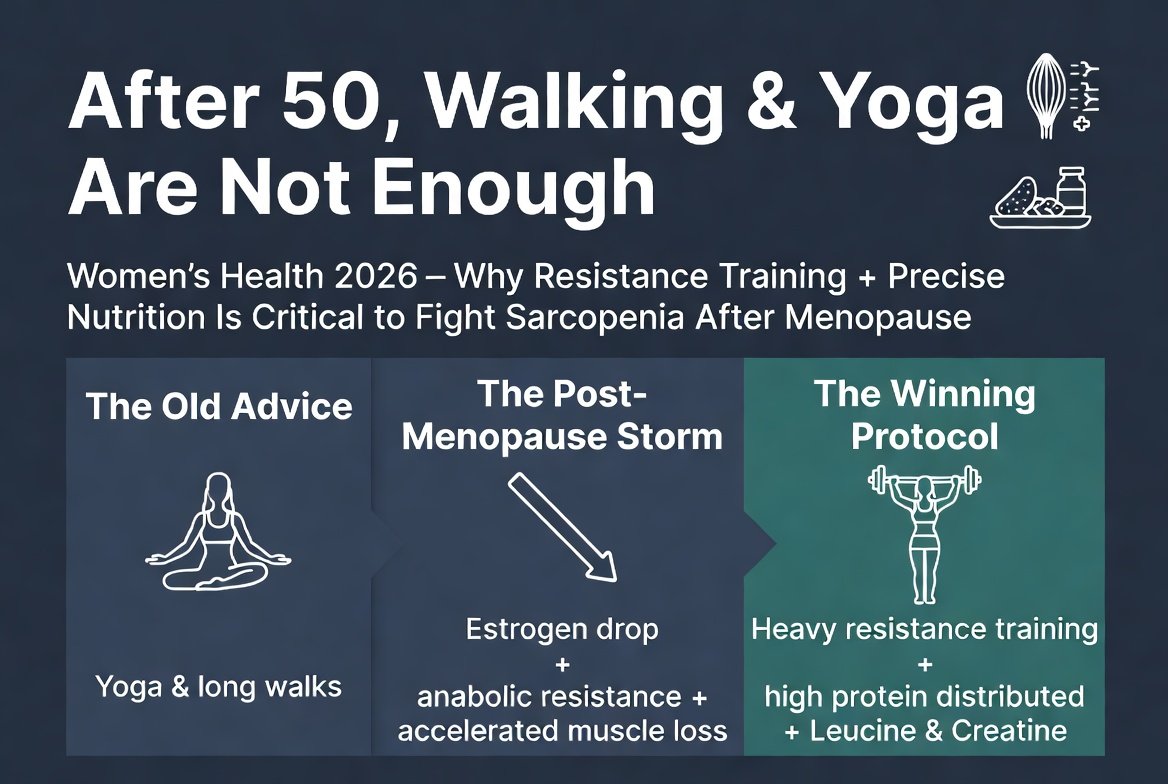
Here is the good news: muscle does not lose its ability to grow; it simply stops receiving the stimulus that demands it to grow. Walking, swimming, and yoga are excellent for heart health, but they do not provide the mechanical load that signals to the muscle, "you must get stronger to handle this." Only resistance training, lifting a weight that challenges the muscle to the point of real difficulty, provides that signal. This is why strength training is not just "another healthy lifestyle recommendation," but the most direct and proven intervention against sarcopenia.
The Mechanism: How Load Becomes Muscle
When you lift a challenging weight, you create microscopic tears in muscle fibers and activate a cascade of biological signals. The most important of these is the mTOR pathway, a master switch that instructs the cell to start building new muscle protein. In older adults, there is a phenomenon called "anabolic resistance": the aging body is less sensitive to muscle-building signals, and therefore needs a stronger stimulus, both in terms of exercise load and protein intake.
Resistance training stops sarcopenia on several levels simultaneously:
- Increasing muscle fiber size (hypertrophy), especially the fast-twitch Type II fibers, which are the first to disappear with age.
- Improving neural recruitment: much of the rapid strength gain in the first few weeks is not new muscle at all, but the nervous system learning to "talk" better to the existing muscle. This is why strength jumps even before the muscle grows.
- Secreting myokines, proteins released by muscle during contraction, which improve insulin sensitivity, reduce inflammation, and benefit the brain and immune system.
Current Evidence
Study 1: Fiatarone from Harvard, 1990, JAMA
This is the study that shattered the ceiling. Maria Fiatarone and her colleagues took ten nursing home residents, average age 90, and put them through a high-intensity resistance training program for only eight weeks. The results for the nine participants who completed it were dramatic:
- Average increase of 174% in muscle strength.
- A 9% increase in the cross-sectional area of the thigh muscle.
- A 48% improvement in walking speed.
Some participants even stopped using their walkers. This is the definitive proof that muscle remains "trainable" even into the ninth decade of life. There was no magic, just appropriate and sufficiently hard load.
Study 2: Muscle Mass and Mortality, Srikanthan and Karlamangla, 2014
In a study published in the American Journal of Medicine, researchers analyzed data from 3,659 older adults from the US NHANES health survey, with follow-up of 10 to 16 years. The finding: people in the top quartile of the muscle mass index had a 20% lower risk of mortality compared to the bottom quartile (hazard ratio 0.80, 95% confidence interval 0.66 to 0.97). The researchers' conclusion was direct: muscle mass, not just the absence of fat, is an independent predictor of longevity.
Study 3: Resistance Training and Mortality, Saeidifard, 2019
A systematic review and meta-analysis published in the European Journal of Preventive Cardiology pooled 11 studies involving 370,256 individuals. The main finding: any amount of resistance training was associated with a 21% reduction in all-cause mortality risk compared to doing none. And when combining strength training with aerobic activity, the risk reduction reached 40%. Particularly interesting: even two training sessions per week were enough to achieve most of the benefit.
Study 4: Meta-analysis in Older Adults with Sarcopenia, 2021
A systematic review published in the European Review of Aging and Physical Activity pooled 14 controlled studies with 561 older adults (ages 65 to 83) already diagnosed with sarcopenia. Resistance training significantly improved strength, physical function, and body composition, emphasizing that even those already in a state of full sarcopenia can derive significant benefit. In other words, it is never too late to start.
The Exercise Prescription: How to Rebuild Muscle
This is the heart of the article. The recommendations are based on the guidelines of the American College of Sports Medicine (ACSM) and the body of research described above.
1. The Sacred Principle: Progressive Overload
If you remember only one thing from this article, let it be this. Progressive overload means gradually increasing the demand on the muscle over time: a little more weight, one more rep, one more set. A muscle that receives the exact same challenge week after week plateaus and stops growing. The vast majority of older adults who train do not progress enough, and this is the number one reason for lack of results.
- When you can perform the upper end of your rep range with relative ease, increase the weight by 2 to 5% in your next workout.
- If no additional weights are available, increase the number of reps or add a set.
- Record your weights and reps. What is not measured does not progress.
2. Frequency: 2 to 3 Workouts Per Week
This is the sweet spot. The Saeidifard study showed that even two workouts per week provide the majority of the mortality benefit, and guidelines recommend at least two workouts covering all major muscle groups. Three workouts will yield slightly more, but do not sacrifice consistency for quantity. Two workouts you stick with for a year are better than five workouts you abandon within a month.
3. Exercise Selection: Compound Before Isolation
Prioritize compound exercises that work multiple joints and muscle groups at once, as they provide the highest return and mimic real-life movements:
- Squat or sit-to-stand, the most direct imitation of the ability to get up independently.
- Deadlift or lifting weight from the floor, strengthens the entire posterior chain.
- Push: chest press, push-ups, or shoulder press.
- Pull: rows or lat pulldowns, essential for posture.
- Step-ups or lunges, for balance and unilateral strength.
4. Dosage: Sets, Reps, and Intensity
- 2 to 3 sets per exercise.
- 8 to 12 reps per set, with the weight heavy enough that the last few reps are genuinely challenging.
- Stop one or two reps short of failure. There is no need to reach complete exhaustion, especially at an older age.
- Rest for one to two minutes between sets.
- A full workout lasts 30 to 45 minutes, no more is needed.
5. Fuel for Building: Protein
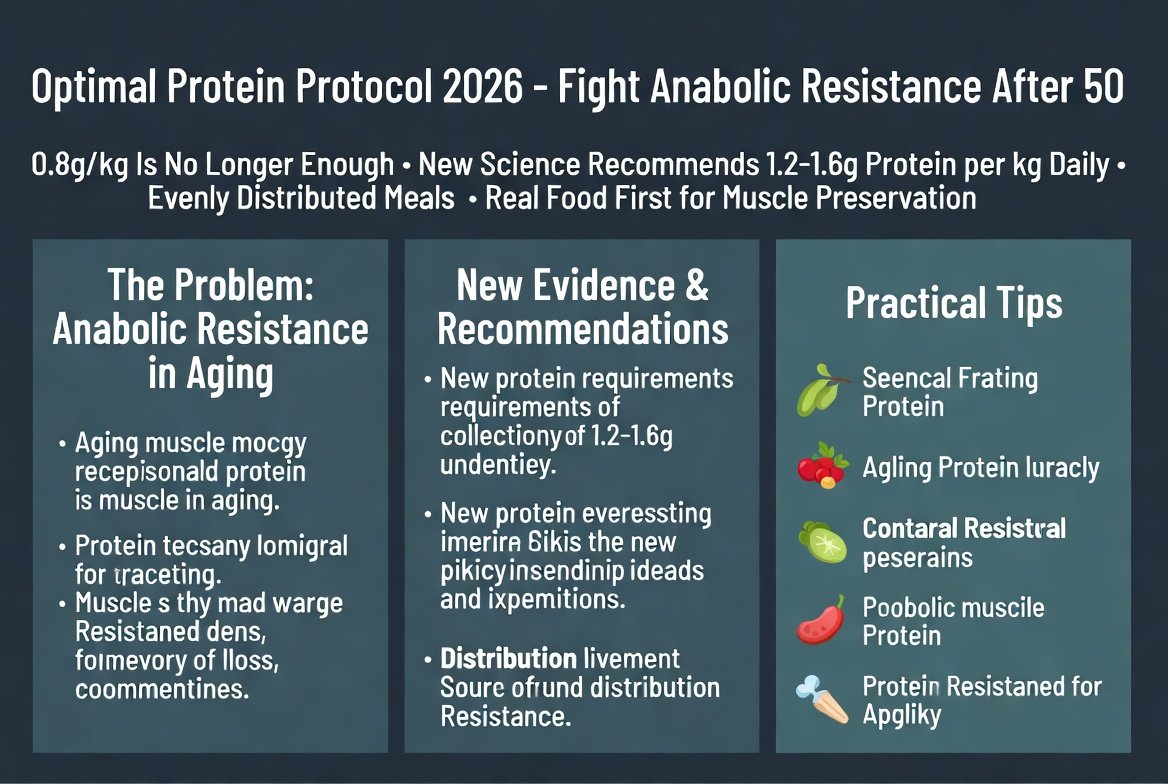
Training without adequate protein is like building a house without bricks. A broad meta-analysis of resistance training (Morton et al., 2018) found that the benefit for muscle building plateaus around about 1.6 grams of protein per kg of body weight per day, making this a good general target for resistance trainees, not a number unique to older age. However, due to anabolic resistance, older adults may need at least this amount to derive the same benefit. It is advisable to distribute protein across 3 to 4 meals with 25 to 40 grams each. The most important protein window is around the workout. The amino acid leucine, found in high concentration in animal protein, is the "switch" that activates muscle building. Those who struggle to reach the target from food can use protein powder. Scientifically, creatine at a dose of 3 to 5 grams per day is also one of the few supplements with strong evidence for building strength in older adults. If you want to understand which supplements truly support muscle and their evidence rating, you can check our supplement matching tool, but remember this is a small addition to training and nutrition, not a replacement for them.
What About Someone Who Has Never Lifted Weights?
If the words "deadlift" and "progressive overload" scare you, that is perfectly fine. You can and should start gently, and the Fiatarone study proves that even the oldest and weakest body responds. Here is a safe entry path:
- First two weeks, bodyweight only: Sit-to-stand, step-ups, wall push-ups, short plank holds.
- Add light resistance: Water bottles, resistance bands, or 1 to 2 kg hand weights.
- Progress gradually according to the principle of progressive overload, and increase weight as soon as the movement becomes easy.
- Consider a trainer at the start to learn proper technique, especially for deadlifts and squats, to prevent injuries.
If you want to turn these principles into a structured program tailored to your age, fitness level, and goals, you can build a personalized training plan that will guide you step by step.
Common Mistakes That Erode Results
- Weight too light: If you can easily do 20 reps, the muscle gets almost no stimulus. Make it challenging.
- No progression: The same weight month after month, see the progressive overload principle.
- Neglecting legs: The leg and glute muscles are the largest in the body and the first to disappear. Do not skip them.
- Too little protein: Without fuel, the workout builds much less.
- Giving up early: Muscle is built over months and years, not weeks. Consistency is everything.
The Broader Perspective
Muscle loss with age is perhaps the biggest health threat no one talks about, and simultaneously one of the few causes of aging over which we have almost complete control. The story of the 90-year-old nursing home residents who regained strength in eight weeks is not a medical miracle; it is a reminder that muscle is always listening. Every set you perform this week is a vote for your independence 20 and 30 years from now: the ability to get up from a chair alone, to carry a grandchild, to climb stairs without thinking about it. The best time to start was two decades ago. The second best time is today. The body has not lost the ability to build muscle; it is just waiting for you to ask it to.
References:
Fiatarone MA et al., High-Intensity Strength Training in Nonagenarians, JAMA 1990
Srikanthan P, Karlamangla AS, Muscle Mass Index as a Predictor of Longevity, Am J Med 2014
Saeidifard F et al., The association of resistance training with mortality, Eur J Prev Cardiol 2019

💬 Comments (0)
Be the first to comment on the article.