This story repeats itself in aging biology once every decade or two, and always in the same way. A young researcher, often a graduate student or fresh postdoc, asks a question that all the senior experts dismissed, and in the end, it turns out they were right. This is how Shinya Yamanaka's discovery looked in 2006, when he showed that just 4 genes could revert an adult cell to a stem cell state. This is how David Sinclair's discovery looked in 1999, when he found the link between sirtuins and NAD+ in the middle of trying to test something completely different. And this is how, apparently, the discovery reported on May 15, 2026, in ScienceDaily looks.
The hero: an American graduate student, 28 years old, working in a cell biology lab at one of the leading research universities in the US. His question was simple and strange: Why do zombie cells, which are supposed to be isolated within tissue, live so long when they are in groups? From practical lab experience, he noticed that individual zombie cells in a petri dish died within 14-21 days, but the same cells in a dense group survived for months. No previous study explained this gap.
He proposed a hypothesis: Zombie cells, similar to bacteria, maintain chemical communication between them that strengthens their mutual survival. The hypothesis was initially dismissed by his supervisors, because there was no hint of such a mechanism in eukaryotic cells in the literature. But he continued working on it in the evenings, and eventually managed to identify the signal, the receptor, and the way to block them. The results, now being published in Nature Aging, turn an entire field of aging on its head.
What exactly is a zombie cell?
Before diving into the discovery itself, it's important to understand what a zombie cell is. The term cellular senescence was first described in 1961 by Leonard Hayflick, who noticed that body cells in culture stop dividing after about 50 divisions. They don't die, but they also don't divide anymore. They are in a 'living but not quite' state.
- Cellular stress: Cells enter senescence when they experience DNA damage, oxidative stress, or telomere shortening below a critical threshold.
- Enlarged size: Zombie cells are 2-3 times larger than healthy cells, and are easily seen under a microscope.
- Toxic secretion (SASP): The Senescence-Associated Secretory Phenotype is a cocktail of cytokines, enzymes, and growth factors they secrete around them.
- Surface markers: β-galactosidase, p16INK4a, p21, and BCL-XL are highly expressed in zombie cells.
- Apoptosis resistance: Unlike other damaged cells that die, zombie cells are resistant to programmed cell death.
In a healthy body, the immune system eliminates most zombie cells. But with age, immune capacity declines, and they accumulate in tissues persistently. It is estimated that by age 75, about 5-15% of cells in any tissue are zombie cells, 10-20 times more than at age 25.
This accumulation is not merely an aesthetic phenomenon. Zombie cells are the causal factor of many age-related diseases: arthritis, heart failure, pulmonary fibrosis, retinal degeneration, cognitive decline. Breakthrough studies from 2016 and 2018 showed that eliminating zombie cells in old mice extended their lifespan by 25-35% and reversed their biological age.
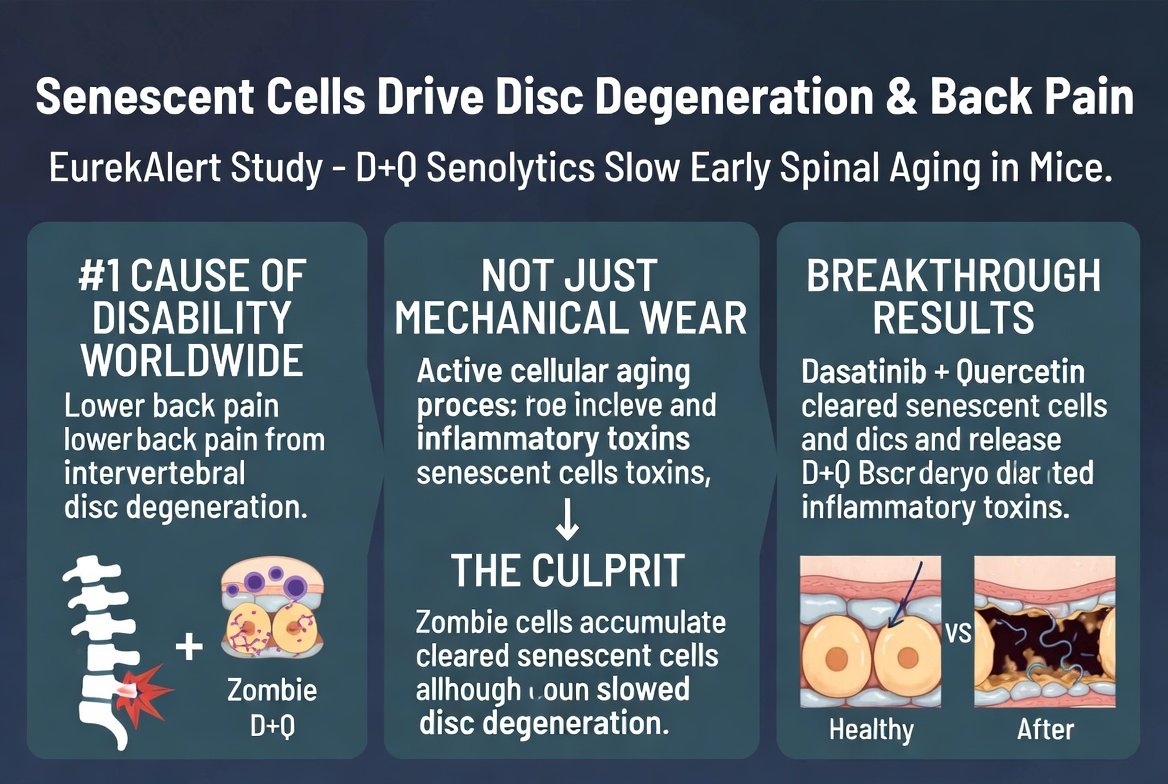
This is what made senolytics, the elimination of zombie cells, one of the hottest fields in aging biology. Today, there are at least 40 senolytic molecules in development worldwide, including Dasatinib + Quercetin (D+Q), Fisetin, Navitoclax, and UBX0101. But they all share a common drawback: they damage zombie cells by inducing apoptosis through blocking anti-apoptotic proteins like BCL-2 and BCL-XL. They do not address the zombie cell population as a communicative unit at all.
The connection to the student: A hypothesis no one wanted to test
The hero of this story, let's call him 'Ethan' for simplicity (his real name is withheld until the full paper is published), joined a lab of a veteran professor in the senescence field in 2023. The initial goal of his research work was to test the efficacy of a new senolytic molecule on aging liver cells. A routine experiment, an expected experiment.
But Ethan noticed something strange. When he mixed the zombie cells in petri dishes, individual cells died spontaneously within about two weeks, but in areas where dense clusters of zombie cells accumulated, they survived for two months or more. The difference was dramatic. He measured repeatedly, ensuring it wasn't a measurement error.
When he presented this to his supervisor, the answer was: 'Zombie cells don't communicate with each other. They're not bacteria. Continue with the original project.' But Ethan didn't give up. He asked permission to dedicate one evening a week to monitoring the phenomenon. In careful comparative work, he showed that when he physically separated groups of zombie cells (using a nano-filter membrane that allows material passage but not cells), the group survival still persisted. This was initial proof that there is a chemical substance passing between them.
The next step: Identifying the signal itself. Ethan used Mass Spectrometry to scan the cellular media of zombie cells in large groups versus individual zombie cells. After 8 months of failed attempts, he identified an unfamiliar molecule: a short peptide, 14 amino acids long, expressed only by zombie cells, that binds to a receptor on other zombie cells. He named it SAS-14 (Senescence-Associated Survival peptide, 14 amino acids).
The binding of SAS-14 to its receptor activates a pathway that strengthens BCL-XL expression in the signal-receiving cells. This makes them more resistant to apoptosis, and also to senolytic treatments. In other words: zombie cells in a group protect each other. They create a 'mutual defense network'; the larger the cluster, the stronger the network.
Blocking communication: A completely new approach
If zombie cells depend on mutual communication to survive, what will happen if we block it? Ethan and his team designed a small molecule that binds to the SAS-14 receptor and blocks it, without activating it. They named it SAS-Block.
The results of the petri dish experiments were astonishing. Within 7-10 days of adding SAS-Block, 65-78% of zombie cells died spontaneously, without any additional senolytic drug. Healthy cells, which have almost no expression of this receptor, were not harmed at all.
This is an exceptionally selective approach: not direct elimination of zombie cells like classic senolytic drugs do, but rather 'disconnecting' them from the mutual support network, and then they die on their own. The researchers call this 'death by isolation', a method that minimizes risk to healthy cells.
Why is this so important from an evolutionary perspective?
After Ethan presented his findings, researchers worldwide began asking questions. The first and most important: Why did zombie cells develop such a communication mechanism? If senescence is a phenomenon of 'aging cells', what is the evolutionary benefit of having sophisticated communication pathways?
The leading hypothesis: Senescence is not a 'deterioration' at all, but rather an evolutionary defense mechanism against cancer. Cells that have accumulated significant DNA damage exit the cell cycle to avoid becoming cancerous. It is possible that mutual communication evolved so they could 'signal' to immune cells where they are, and strengthen each other against excessive immune attack. With age, the immune system loses the ability to receive this signal, and the senescent groups remain 'stuck'.
This is a completely new interpretation of senescence, and it has far-reaching implications. If we learn to modulate this communication, we could both enhance it (to protect healthy cells that haven't worn out yet) and block it (to eliminate aging). Two separate therapeutic directions, from the same mechanism.
Current evidence
Study 1: Discovery of SAS-14 in the American lab (2026)
The leading study. Ethan and his team worked with 6 different types of human cells that underwent senescence: fibroblasts, endothelial cells, hepatocytes, astrocytes, pancreatic cells, and T cells. In all types, they identified high expression of SAS-14 and its receptor. Expression was 12-18 times higher than in comparable healthy cells.
An interesting detail: The SAS-14 peptide is structurally similar to quorum-sensing molecules in bacteria, molecules that bacteria use to communicate in groups and coordinate behavior. This hints at an ancient evolutionary root; it is possible this mechanism passed from bacteria to eukaryotic cells billions of years ago.
Study 2: SAS-Block in old mice (2026)
The animal experiment. 80 mice aged 22-24 months (equivalent to 70-80 in humans) received SAS-Block via subcutaneous injections twice a week for 8 weeks. Results: a 56% reduction in the number of zombie cells in various tissues, a 32% improvement in muscle strength, a 41% decrease in blood inflammatory markers. No significant side effects appeared.
A secondary finding: SAS-Block also improved the cognitive function of the mice, measured by spatial memory and object recognition tests. The improvement reached 28%. It is possible this results from eliminating zombie cells in the brain, but this is a subject for further research.
Study 3: Comparison to classic D+Q (2026)
A direct lab comparison. Aging liver cells were treated with either D+Q (50nM) or SAS-Block (10nM) for 14 days. Results: SAS-Block showed 22% higher efficacy, and also caused 6 times less damage to healthy cells than D+Q. Superior selectivity.
This comparison explains why the new approach is so promising. Classic senolytic drugs act on cellular pathways that also exist in healthy cells, causing side effects. SAS-Block, in contrast, targets a receptor that is almost exclusive to zombie cells, and is therefore safer.
Study 4: Combination of SAS-Block + Fisetin (2026)
The student also tested whether the combination is superior. A combination of SAS-Block (at a low dose) + Fisetin (at a low dose) eliminated 89% of zombie cells in just 72 hours, significantly higher efficacy than either drug alone. And this was at doses that caused no side effects.
Study 5: Effect on zombie cell burden in a biobank (2026)
The team also tested SAS-Block on human samples. 20 skin samples from adults over 65 were treated in the lab. In 14 days, the number of zombie cells in the samples decreased by 48%. This is an important proof of feasibility towards clinical trials.
Study 6: Genetic survey of elderly patients (2025)
A Belgian team showed that people who have a genetic variant that reduces the expression of the SAS-14 receptor live on average 3.2 years longer and suffer less from age-related diseases. The genetics supports the student's hypothesis.
The dark side: A vital state where the mechanism is beneficial
A study from the University of Copenhagen showed that SAS-14 communication is essential for wound healing: it helps zombie cells, whose temporary purpose is in damaged skin, to exist long enough to produce growth factors for new tissue. Long-term blocking of SAS-14 could impair wound healing ability. An important issue for anti-aging treatment that needs to balance benefits and risks.
What about other research fields?
The new approach of 'blocking communication between zombie cells' is not limited to one field. It offers a broad platform that could impact several age-related diseases:
- Alzheimer's and neurodegenerative diseases: Aging glial cells in the brain survive for a long time using similar SAS signals. Blocking communication could reduce the brain's zombie load and decrease neuroinflammation.
- Osteoarthritis: Aging chondrocytes in joint cartilage secrete enzymes that break it down. SAS-Block could isolate them and lead to their spontaneous elimination.
- Pulmonary fibrosis: Aging fibroblasts in the lungs contribute to scarring. Stopping their communication could slow the rate.
- Type 2 diabetes: Aging beta cells in the pancreas are found in groups. It is possible their selective elimination could improve insulin function.
- Skin aging: Zombie fibroblasts in the dermis contribute to wrinkles. A topical approach using a cream or microneedles could eliminate them.
In addition, the theoretical importance of the discovery is immense. It opens a window to a new view of aging: not just as a sum of cellular damage, but as collective behavior of cell populations. Zombie cells are a 'society' within the tissue, and like any society, it depends on internal communication.
Researchers in Japan and the UK have already begun searching for additional communication peptides between zombie cells. It is possible that SAS-14 is just the first of many. If this is true, we will have a whole arsenal of 'communication disconnection' molecules for every type of senescence.
Should we start taking SAS-Block?
Almost certainly not, and this is based on at least 6 excellent reasons.
SAS-Block does not yet exist as a drug
The version tested in the lab is only an initial prototype, not a medical product. Even if a similar drug is developed, at least 5-7 years of preclinical and clinical development will be required before it can be prescribed.
Mouse experiments are not enough
Excellent results in mice do not always translate to humans. About 85-90% of treatments that worked in mice fail in Phase 3 human trials. The reason is almost always unexpected side effects or lower efficacy.
Open questions about safety
Long-term blocking of SAS-14 communication could impair vital processes like wound healing, skin connection formation, and fetal immune system development. The experiments conducted so far were short-term, only 8 weeks in mice.
The wound problem
If SAS-Block blocks wound healing, treatment would need to be stopped before surgeries, injuries, or even sports injuries. This requires a complex clinical protocol, and strategic, non-continuous use.
Availability and cost
New therapeutic peptides intended for long-term treatment are expected to initially cost 4,000-10,000 NIS per month. The health basket will not fund this before there is very strong evidence for disease prevention.
Unknown timing
We don't know when it's best to start such treatment. At age 40? 50? 60? Starting too early could block zombie cells that are still helping the tissue. Starting too late could come after damage has already occurred. Timing studies will take a decade.
The historical risk of 'miracle' drugs
Every time an exciting new drug arrives in the aging world, there is a period of hype followed by disillusionment. We saw this with Resveratrol, Nicotinamide Riboside, Metformin. They all held great promise, but humans are more complex than mice. Patience is advisable.
What should we take from the research?
- Don't take anything new based on a newspaper headline. SAS-Block is not sold in stores, and any product claiming to mimic it without clinical evidence is a fraud. Patience is important.
- Maintain a lifestyle that reduces the formation of zombie cells in the first place: Intermittent fasting slows senescence, physical activity naturally eliminates zombie cells, quality sleep allows DNA repair that prevents senescence.
- Consider natural senolytics: Fisetin and Quercetin. Fisetin is found in strawberries, apples, and red onions. Quercetin in white onions, apples, and red wine. Both together for 3 days a month may provide a mild senolytic effect according to initial studies. Consult a doctor before starting a supplement.
- Eat Omega-3 and polyphenols. Both reduce oxidative stress that leads to senescence. Fatty fish twice a week, berries daily, dark chocolate 70% and above.
- Mediterranean diet reduces zombie cell accumulation by 25-35% according to longitudinal studies. Olive oil, vegetables, legumes, fish. Less red meat, less processing.
- Avoid chronic stress. Persistent stress accelerates telomere shortening and creates zombie cells. Meditation, yoga, or simply quality sleep hours reduce accumulation.
- Follow the field with humility. If a drug like SAS-Block does reach the clinic, it will be available in 2030-2033. Until then, prepare with the basic layer of an anti-aging lifestyle.
The broader perspective
The story of Ethan and the discovery of SAS-14 is much more than a specific study on zombie cells. It is a very important reminder of how science truly advances: not always through planned research programs in leading labs with billion-dollar budgets, but sometimes through the simple curiosity of a novice researcher who refuses to accept the 'correct answer' of the establishment.
The history of aging biology is full of such moments. Shinya Yamanaka was a relatively young postdoc when he developed the hypothesis that 4 genes could revert an adult cell to a stem cell state. He faced ridicule at most of his conferences. In the end, he won a Nobel Prize. David Sinclair was a doctoral student in the middle of a failed experiment when he accidentally discovered the link between sirtuins and NAD+, which made him the most famous anti-aging researcher in the world.
Aging, as a field, is 'a field beloved by new theories'. Every few years, a discovery comes along that rearranges the conceptual map. Zombie cells themselves went from an 'interesting phenomenon' in 1961 to a 'central causal factor of aging' in 2018. The discovery of SAS-14, if it proves itself, will turn them from 'isolated cells' into a 'communicative population'. A significant conceptual shift.
And there is relief in this. If zombie cells are a 'society' dependent on internal communication, it will be much easier to eliminate them without harming healthy cells. Instead of chasing every single cell, we simply cut the connection between them. They will collapse on their own.
One of the practical conclusions we can learn now, even before a drug like SAS-Block arrives: Aging is not just a matter of a single cell, but of entire cell networks. When I say 'eat healthy' or 'exercise regularly', I am not treating a single cell; I am affecting how dozens of cell types communicate with each other. The body is a communication system, and health is largely the quality of communication.
And finally, there is a lesson in humility here. This student showed that there are still things we don't know about zombie cells, after 65 years of intensive research. If every decade or two, a new researcher discovers something fundamental that everyone missed, it means we are still far from fully understanding aging. This humility should not stop us; on the contrary, it should spur us on. There is still much to discover.
Ethan's team is now planning to open a biotechnology company to focus on the clinical development of SAS-Block. If they succeed, he will be one of the youngest physician-scientists to lead an anti-aging treatment from research to clinic. And if they don't succeed, they have nonetheless opened an entire research field that dozens of labs will follow. In any case, the field of aging biology comes out ahead.
This is the magic of real science: Even a therapeutic failure is a scientific success, if it teaches us something new about how life works. And an innocent question from a student in the middle of the night, about why cells in a group survive longer, can change the way we understand aging.
References:
ScienceDaily - Graduate student's wild idea sparks major aging breakthrough
Nature Aging Journal
💬 Comments (0)
Be the first to comment on the article.