For decades, the idea of a drug that selectively eliminates zombie cells, those senescent cells that refuse to die and poison the surrounding tissue, sounded like science fiction. Today, in mid-2026, it is an active research field with several biotech companies trying to crack it, early clinical trials, and also resounding failures. But it is important to understand one thing from the start: there is currently no senolytic drug approved by the FDA for the purpose of aging, and the road there is long and bumpy.
The starting point for this article is a real and exciting scientific discovery published in 2026. A team of researchers from the MRC Laboratory of Medical Sciences (MRC LMS) and Imperial College London, led by Mariantonietta D'Ambrosio, published a study in Nature Cell Biology that identified a surprising vulnerability of senescent cells: they depend on a protective protein called GPX4 to survive, and without it they die through a mechanism called ferroptosis, an iron-dependent cell death. This is one of the most important scientific developments in the field, and it is the real basis for some of the drugs currently in development.
In this article, we will dive into the real state of senolytic drug development, without hype and false promises. We will see which companies actually exist and what they are doing, which trials succeeded and which failed, and what this means for those seeking a real, approved, and safe treatment.
What is a senolytic drug, and why is it a hot research field
A senolytic drug is a molecule that selectively targets zombie cells, those cells that have stopped dividing but haven't died, and that secrete an inflammatory cocktail of molecules (SASP) that damages the surrounding tissue. The idea is simple: identify the zombies, kill only them, and allow the tissue to regenerate. In practice, designing such a molecule, which is both effective and safe for use, has proven much harder than hoped.
- First generation senolytics: Drugs that already existed and were repurposed, such as dasatinib (originally a leukemia drug) combined with quercetin (a flavonoid), and fisetin (a flavonoid). These are the real and most studied senolytics in humans today.
- Second generation, in development: New molecules specifically designed to target senescent cells, such as GPX4 inhibitors that exploit the ferroptosis mechanism described above. These are still in early stages.
- The new GPX4 mechanism: The 2026 study showed that senescent cells are under high oxidative stress and loaded with iron, a condition that puts them at risk of ferroptosis, but they defend themselves by overproducing GPX4. Blocking this protein removes the shield and leads to their selective death.
The reason this is a hot research field is that it offers a completely different approach to age-related diseases: instead of treating each disease separately after it breaks out, perhaps it is possible to treat a common cause, the accumulation of zombie cells. But between the promising idea and an approved drug, there is a huge gap, and several companies have already been burned along the way.
The real players in the field, and the correct facts
Contrary to the impression of a mature industry with molecules in advanced approval stages, the real picture is much more modest. Here is what is actually happening.
Unity Biotechnology: A cautionary tale
Unity Biotechnology was founded in 2011 by Nathaniel David, Jan van Deursen, and Judith Campisi, three pioneers in the senolytics field. The company was considered groundbreaking, but its story is actually a cautionary tale about the difficulty of the field. In September 2025, the company entered liquidation: the certificate of liquidation was officially filed in the state of Delaware on September 26, 2025, after being delisted from the NASDAQ stock exchange. It is no longer a "leading pioneer with active Phase 3 trials", but a company that is shutting down.
Unity's two lead drugs failed in trials. UBX0101 for knee osteoarthritis: A Phase 2 trial in 183 patients (2020) failed to show a statistically significant difference versus placebo on the WOMAC-A pain score at week 12, and development was halted. UBX1325 (foselutoclax), a BCL-xL inhibitor for diabetic macular edema (DME, not wet AMD): In a Phase 2b trial called ASPIRE (2025), which included 52 patients, the drug missed the primary endpoint of non-inferiority versus aflibercept at weeks 20-24 (a modest improvement of about 5.2 letters in visual acuity at week 24, but without meeting the predefined statistical goal).
The lesson from Unity is clear: even the oldest and best-funded company in the field failed to bring a senolytic drug to the finish line. This is a reminder of how early and uncertain this field is.
Cleara Biotech: Preclinical research only
Cleara Biotech is a Dutch company developing the peptide FOXO4-DRI, which is supposed to disrupt the interaction between p53 and FOXO4 in senescent cells and cause them to selectively self-destruct. The important fact: FOXO4-DRI is in the preclinical stage only, and no human trials have been conducted with it. Moreover, it is a relatively large peptide (about 34 amino acids), and the blood-brain barrier blocks it, so there is no basis for claims about treating brain zombies with it. The research so far has been based on cells in vitro and on mice.
Rubedo Life Sciences: The real human trial
Rubedo Life Sciences is an American company that raised about $40 million in a Series A round in April 2024, led by Khosla Ventures and Ahren Innovation Capital. Their lead drug, RLS-1496, is a modulator of the GPX4 protein, meaning it is built precisely on the ferroptosis mechanism described above. This is the only innovative senolytic that has already entered a clinical trial in humans: it is in Phase 1, intended for the dermatology field (psoriasis, atopic dermatitis, skin aging, and actinic keratosis), as a topical formulation, and the first patient was treated in 2025. This is a promising start, but it is still Phase 1 in a narrow field, far from a general anti-aging drug.
Other players
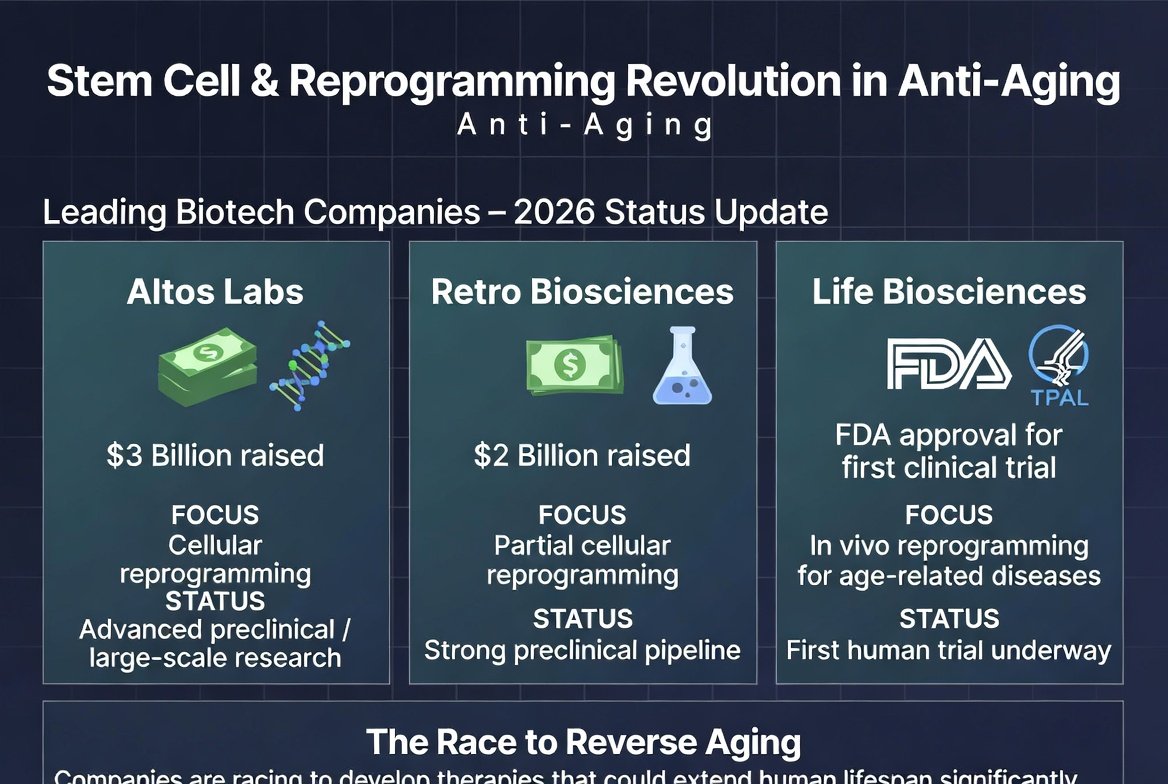
Other companies operate in the field, such as Altos Labs, which focuses mainly on cellular reprogramming and not directly on senolytics. It is also important to clarify what does not exist: there is no $500 million senolytic program from Genentech, and Genentech's GNE-987 is actually a BRD4 PROTAC for oncology (leukemia and osteosarcoma), not a senolytic for pulmonary fibrosis. There is also no NIH study on 320 older adults treated with senolytics for two years. All of these appeared in erroneous reports, and they are simply not true.
The real evidence: What is actually being studied in humans
Dasatinib + Quercetin (Mayo Clinic, Kirkland Lab)
These are the most studied senolytics in humans, from the lab of James Kirkland at the Mayo Clinic. In a small pilot trial in patients with diabetic kidney disease, the combination of dasatinib and quercetin successfully reduced the number of senescent cells in fat and skin biopsies, and this was one of the first proofs that senolytics can indeed reduce zombie burden in humans. Additional trials are testing this combination in conditions like osteoporosis. However, these are small and early trials, not proof of broad clinical efficacy.
Fisetin (Flavonoid)
Fisetin, a natural flavonoid found in strawberries and other fruits, is also being studied as a senolytic in several trials at the Mayo Clinic and elsewhere, including an arm in a Phase 2 trial in older women with osteoporosis. Again: a real and promising research area, but without solid clinical proof of efficacy yet.
The GPX4 discovery (D'Ambrosio et al., 2026)
This is the newest and most important scientific evidence. In a study published in Nature Cell Biology, the researchers screened a library of 10,480 molecules and identified a subset that selectively kills senescent cells. They discovered that these molecules, such as GPX4 inhibitors, cause senescent cells to die by ferroptosis. The understanding that senescent cells depend on GPX4 to survive opens a new door for more precise senolytic drugs, and it also explains why Rubedo's approach (a GPX4 modulator) makes sense. The study also showed that combining GPX4 inhibitors with oncological treatments eliminates senescent cancer cells in models of melanoma, prostate cancer, and ovarian cancer.
Should you start taking senolytic drugs?
The short answer: No, not right now. Here's why.
No senolytic is approved for anti-aging
As of 2026, no senolytic drug is approved for treating aging as a target. Dasatinib is approved for leukemia, and fisetin and quercetin are natural flavonoids sold as supplements. Using any of these for anti-aging purposes is off-label or unsubstantiated, and can be dangerous (dasatinib in particular has significant side effects).
An early field with proven failures
The story of Unity Biotechnology, with its two clinical failures and liquidation, illustrates that the field is still far from maturity. A drug that works perfectly in mice can fail completely in humans. Caution and sobriety are the right approach right now.
Beware of clinics and commercial "senolytic treatments"
Already today, there are private clinics offering expensive "senolytic treatments" without clinical validation and without regulatory oversight. Many of them use high-dose fisetin cocktails or off-label dasatinib. The risk, both health and financial, is real. Until approved drugs exist, avoid this.
When yes? Participation in clinical trials
The safest way to access innovative senolytic treatments is participation in an official clinical trial, where medical supervision and data collection are controlled. You can search on clinicaltrials.gov or contact tertiary hospitals in Israel for information.
What can you do today?
- Do not buy commercial "senolytics" online or at private clinics. There is no approved senolytic drug, and even fisetin and quercetin in high doses can be harmful.
- Follow developments cautiously. The GPX4 discovery and Rubedo's trial are real steps forward, but they are still early. If you have an advanced age-related disease, check if there is a relevant clinical trial.
- Invest in interventions with a solid foundation. Unlike senolytic drugs, a healthy lifestyle is well-tested. However, it is important to be precise: human studies (like the CALERIE trial on caloric restriction) showed a modest and not unequivocal effect on markers of senescent cells, not dramatic reductions. So don't expect a miracle, but physical activity, good nutrition, and quality sleep undoubtedly help overall health.
- Eat a diet rich in polyphenols. Strawberries, apples, onions, tomatoes, and dark chocolate contain natural fisetin and quercetin in safe doses. The effect is subtle, but it is a healthy way to consume them.
- Maintain a strong immune system. Vitamin D, zinc, and physical activity support the immune system, which naturally removes senescent cells. This is general support, not a targeted treatment.
The broader perspective
The senolytics field is not just a story about new drugs; it is a test of the idea that we can treat the root cause of age-related diseases and not just the symptoms. The idea is exciting, and the discovery of GPX4 and ferroptosis shows that basic science continues to advance. But the road from the lab to the clinic is long.
It is important to remember history for perspective. Statins, the cholesterol-lowering drugs, were first approved only in 1987 (lovastatin, under the brand name Mevacor). Today they are among the most common drugs in the world, but the path there took years of research and trials. Senolytics may follow a similar path, but they may not, and right now it is too early to know.
It is also important to guard against inflated promises. Reports describing a "billion-dollar industry" with "dozens of trials in advanced stages" aiming for approval within two to three years, or promises of "7-10 additional years of health," do not reflect reality. The reality is more modest: an active research field, mostly early trials, failures alongside partial successes, and not a single approved drug for aging.
The right approach for the Israeli consumer and anyone following the field is healthy curiosity combined with sobriety. Worth following, not worth rushing. When a real senolytic drug passes Phase 3 trials and receives FDA approval, it will be big news, and we will know about it. Until then, the best promise for health in old age remains what it always was: a healthy lifestyle, medical monitoring, and caution against promises that sound too good to be true.
The senolytic pipeline is one of the most interesting stories in aging medicine, but it is at the beginning of the road, not the end. It will not guarantee us immortality, nor a miracle drug in the coming years, but the science behind it is real, and the progress, though slow, is real. And that, ultimately, justifies careful and hopeful monitoring.
References:
Nature Cell Biology - Electrophilic compound screening identifies GPX4-dependent ferroptosis as a senescence vulnerability (D'Ambrosio et al., 2026)
ScienceDaily - New drugs could wipe out the zombie cells linked to cancer and aging


💬 Comments (0)
Be the first to comment on the article.