Elizabeth Blackburn won the 2009 Nobel Prize in Medicine for discovering telomeres and the enzyme that maintains them, telomerase. Most researchers after a Nobel go into advanced fields, but Blackburn did something unexpected: she entered the study of the connection between stress, meditation, and telomeres. The results expanded our understanding of what we might be able to do for our cells through our mind. If you were looking for one good reason to start meditating, here is a research-based one.
The Story: Why Blackburn Entered Stress Research
In the early 2000s, Blackburn worked with Elissa Epel, a psychologist at UCSF. They wanted to know if chronic stress affects telomeres. They examined mothers caring for chronically ill children, a population with very high stress levels. The finding, published in PNAS in 2004:
- Their telomeres were shorter than those of mothers of healthy children (a gap of about 550 base pairs, roughly 15%)
- The shortening was proportional to the duration of the stress period
- Their telomerase activity was lower
In terms of cellular aging, the interpretation that gained wide publicity: the women who experienced the most prolonged stress carried telomeres corresponding to about 9 to 17 additional years of aging. Chronic stress, it turns out, physically leaves a mark on cells.
The next question was obvious: If stress shortens telomeres, do relaxation and meditation have the opposite effect?
The Shamatha Project
A team of researchers, led by Clifford Saron from UC Davis and in collaboration with Epel and Blackburn, set out to investigate. They studied the Shamatha Project, a study on intensive meditation, and published the findings in the journal Psychoneuroendocrinology in 2011 (Jacobs et al.).
The experiment:
- About 30 participants who underwent a retreat of about 3 months
- About 6 hours of meditation per day
- A control group of about 30 people waiting for the next round, matched for age, sex, and BMI
- Blood tests to assess enzyme activity
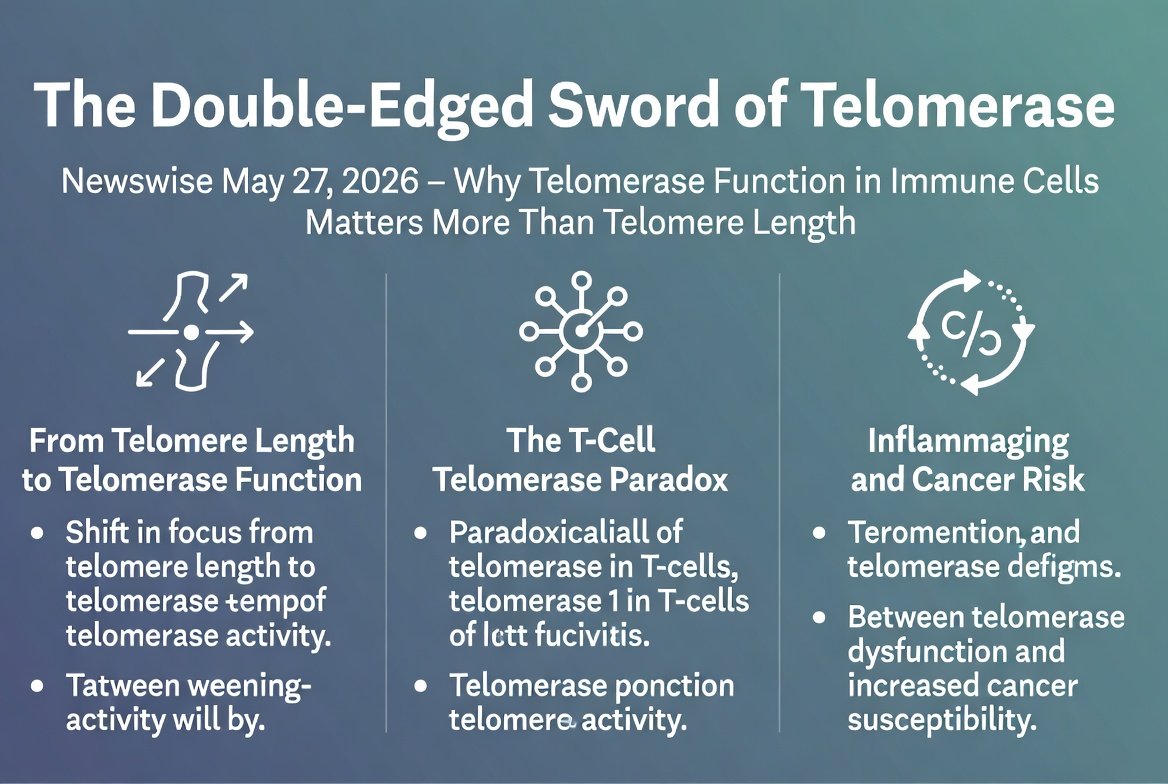
Important to distinguish: they measured telomerase activity in white blood cells, not the length of the telomeres themselves. These are two different things.
The Findings: About 30% Increase in Telomerase Activity
At the end of the retreat:
- Telomerase activity in the meditation group was higher by about a third (roughly 30%) compared to the control
- The difference was not directly explained by the number of meditation hours, but was mediated through psychological changes
- People with a stronger sense of purpose and an increase in sense of control showed a greater increase
- A decrease in neuroticism and an increase in mindfulness also predicted the rise in telomerase
The researchers themselves were very cautious about jumping to a direct causal conclusion. Clifford Saron, who led the project, emphasized that meditation may improve mental well-being, and that those mental changes are associated with telomerase activity in immune system cells, not necessarily directly causing it. In other words: this is a documented and measurable link, but not proof that meditation "repairs cells" on its own.
How Might It Work?
The mechanism is complex, but researchers point to two possible pathways:
Pathway 1: Stress and Cortisol
Chronic stress keeps cortisol levels high. Cortisol:
- May suppress the expression of telomerase components (TERT, TERC) in blood cells
- Promotes systemic inflammation, which damages telomeres
- Impairs sleep quality, thereby also harming cellular maintenance processes
Meditation helps lower cortisol, and this may ease the barrier.
Pathway 2: Positive Psychological Factors
In the study, what best predicted the increase in telomerase was not how much meditation a person did, but how it made them feel:
- Sense of control over life
- Sense of purpose
- Mindfulness (attention to the present moment)
- Less neuroticism (less anxiety)
These mental changes are accompanied by neurochemical changes, and they may indirectly affect blood cells and telomerase activity. This is precisely where caution lies: the link is measured, but the full causal chain has not yet been cracked.
But Who Can Do 6 Hours of Meditation a Day?
This is the practical question. Most studies showing a significant effect used intensive retreats. So what about people living normal lives?
Here the picture is more modest. A large randomized controlled trial, Age-Well (published in 2024), examined adults aged 65 and over who underwent an 18-month meditation program (about 20 minutes of practice per day) compared to control groups:
- No significant effect on telomere length was found in the meditation group compared to the control
- A general decrease in telomere length over time was observed in all groups, with no between-group difference
The honest conclusion: moderate daily practice over time is a healthy and recommended habit for many reasons, but we have no strong evidence that it "lengthens" telomeres. It is certainly not automatically equivalent to an intensive retreat, and dramatic cellular results should not be promised from it.
Which Techniques Were Studied?
The research focused mainly on mindfulness meditation, attention to the present moment. Also examined were:
- Loving-kindness meditation: compassion meditation. In separate studies (e.g., Hoge 2013, Le Nguyen 2019), a link was found to telomerase activity and telomere length
- Transcendental meditation: about 20 minutes twice a day
- Yoga combined with meditation: programs of this type were studied and found to be associated with changes in cellular aging markers
- Slow breathing exercises: these also reduce stress
What almost doesn't help: "forced" meditation that creates pressure ("I must sit for 30 minutes without moving a muscle!"). Forced effort creates stress. The principle is to be comfortable, not to fight.
Practical Home Program
If you want to establish a habit within 8 to 12 weeks:
- 10 minutes of meditation every morning: before coffee, before the phone. Eyes closed, deep breaths, focus on the air going in and out
- 10 minutes in the evening: before sleep. Reviewing the day from a non-judgmental stance
- Once a day, at least 2 minutes of "STOP": Stop, take 5 deep breaths, return
- Apps help: Headspace, Calm, Insight Timer. They guide you step by step
- Moderate physical activity: greatly aids meditation. Moderate physical fatigue facilitates calmness
What Not to Expect?
It's important to calibrate expectations:
- You won't become a monk. Stress will return even after meditation
- But you may react to it differently. That's the real change
- Your telomeres won't dramatically lengthen. At best, they might shorten more slowly, and even that is not guaranteed
- This is not a substitute for anxiety or depression medication. It's a complement, not a replacement
The Broader Context
If you connect the studies together, a cautious but interesting picture emerges: the way we cope with stress is linked to the health of our cells. It's not "just in the mind," there is biochemistry here. People who manage stress better tend to have longer telomeres and healthier life years. This is one of the most interesting connections we know between the mind and body, even if causality is still being studied.
Elizabeth Blackburn herself is known for her stance favoring lifestyle interventions, like stress management, over "telomerase-activating" drugs whose efficacy and safety are unproven. The logic is simple: stress management, sleep, and physical activity have a broad evidence base and very few side effects, while preparations claiming to lengthen telomeres are still far from proof.



💬 Comments (0)
Be the first to comment on the article.