Aging is a complex and multifaceted process, involving many changes at the molecular, cellular, tissue, and organ levels.
As a result, older cells lose their ability to function optimally, leading to a decline in body function and an increase in the incidence of diseases.
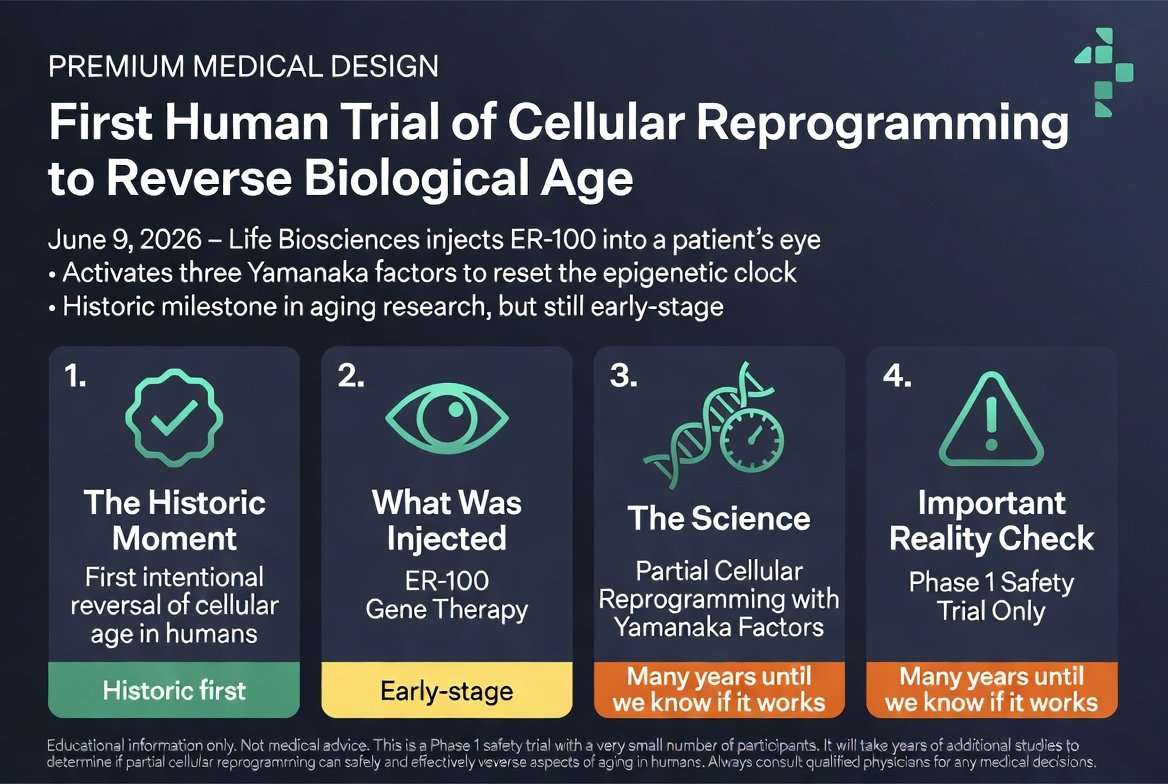
Reprogramming is an innovative research approach aimed at returning old cells to a younger state.
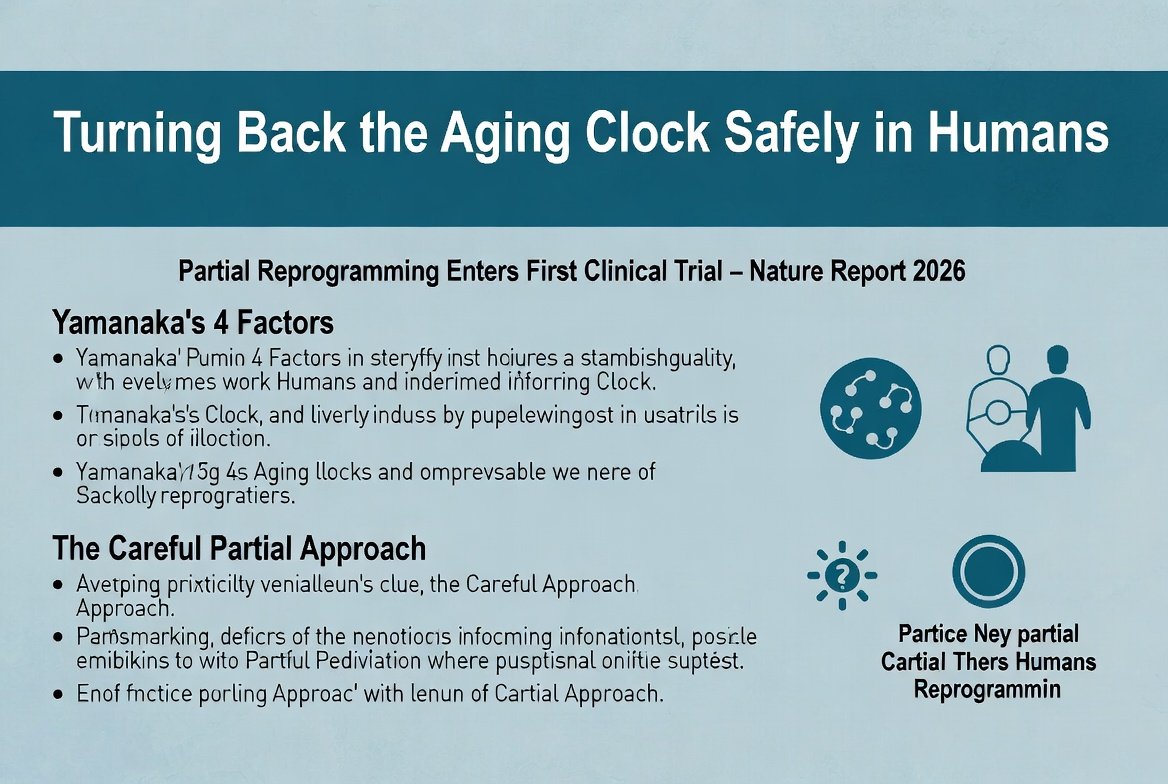
Its most well-known version is based on the re-expression of Yamanaka factors,
a group of genes central to converting somatic cells into iPS cells (induced pluripotent stem cells).
Partial reprogramming is an evolving version of this approach.
Unlike full reprogramming, which leads to the conversion of somatic cells into iPS cells,
partial reprogramming seeks to induce more defined changes in the cell while preserving its identity.
This approach may be inherently safer and opens new research possibilities in the field of aging.
A study published in 2024 in the journal eLife examines the potential of partial reprogramming.
A team of researchers from the lab of Vadim Gladyshev at Brigham and Women's Hospital and Harvard Medical School, including Wayne Mitchell, Ludger Gumina, and Alexander Tyshkovskiy,
examined the effects of partial reprogramming on cells grown in the lab.
It is important to clarify upfront: The study was conducted entirely on mouse fibroblast cells grown in a lab dish (in vitro), not on whole animals or humans. The researchers isolated fibroblasts from young (4-month-old) and old (20-month-old) mice and compared them.
This study used a variety of advanced methods to examine the effects of partial reprogramming on cells:
1. Chemical Partial Reprogramming:
- The researchers used cocktails of small compounds (chemical molecules) designed to induce partial reprogramming.
- Unlike genetic reprogramming, the chemical cocktail in this study acted through a mechanism distinct from the activation of Yamanaka factors. In fact, the most effective cocktail (designated 7c) did not increase the expression of Sox2 and Oct4, and even reduced the expression of Nanog and Myc.
- That is, cell rejuvenation was achieved here via a chemical pathway different from classical Yamanaka factor-based reprogramming.
2. Fibroblasts:
- The study focused on fibroblasts, cells found in connective tissues.
- These cells were chosen because they are relatively easy to grow in the lab and allow for precise measurements.
- Another advantage is that fibroblasts are extensively studied in the context of cellular aging.
3. Comprehensive Molecular Analyses (multi-omics):
- After performing partial reprogramming, the researchers analyzed the cells at different levels:
- RNA-seq: Analysis of the cells' RNA sequences, allowing identification of changes in gene expression.
- Proteomics and Phosphoproteomics: Quantitative analysis of proteins and protein phosphorylation, allowing identification of changes in protein levels and function.
- Metabolomics: Analysis of metabolites in the cell.
- DNA Methylation: Measurement of DNA methylation patterns, used to calculate epigenetic clocks.
4. Functional Measures:
- In addition to molecular analyses, functional measures were also assessed, such as:
- Cellular Respiration: A measure of mitochondrial function (cellular organelles essential for energy production), measured using respirometry.
- Mitochondrial Membrane Potential: Another measure of mitochondrial function.
5. Comparison Between Young and Old Cells:
- The study included a comparison between results obtained from young cells and old cells that underwent partial reprogramming.
- This comparison allowed examining whether the effect differs between young and old cells.
Advantages of the Research Methods:
- Use of advanced and precise technologies.
- In-depth analysis at different levels, from methylation and transcription to proteins and metabolites.
- Examination of functional measures.
- Comparison between young and old cells.
Study Results:
The partial reprogramming treatment caused changes at both the transcript and protein levels:
1. Changes at the Transcript Level:
- RNA-seq analysis showed changes in the expression of many genes.
- Some of the changes were related to metabolic processes, including those associated with mitochondria.
2. Changes at the Protein Level:
- Proteome analysis showed changes in protein levels and function.
- Again, changes were observed in proteins involved in metabolic and mitochondrial processes.
3. Functional Effects:
- The researchers reported changes in measures of cellular function, as found in cellular respiration and mitochondrial membrane potential.
- According to epigenetic clocks (methylation-based) and transcriptomic clocks calculated on the cells grown in the lab, the estimated biological age of the cells decreased.
4. Comparison Between Young and Old Cells:
- The changes induced by the cocktails were very similar across the different age groups, with a high correlation between young and old cells.
- In other words, the effect was not limited to old cells but was also observed in young cells.
Conclusions:
This study provides preliminary evidence that chemical partial reprogramming may rejuvenate cells grown in the lab, at least according to molecular measures and biological clocks.
However, it is important to qualify: this is only in mouse cells in a dish, not in whole animals or humans.
The leap from lab results to treating age-related diseases, such as cardiovascular disease, Alzheimer's, or cancer, is distant and speculative at this stage and will require much further research, including animal studies and eventually human trials, before clinical application can be discussed.
.
References:
https://elifesciences.org/articles/90579

💬 Comments (0)
Be the first to comment on the article.