Coffee, the world's most popular beverage, is known for its stimulating effect and unique taste.
In a new study measuring telomere length and its association with coffee consumption
The researchers used multivariate statistical analyses to analyze data from 468,924 participants aged 37-73.
This data included information on coffee consumption (general, instant, and filtered), demographic data, lifestyle, and health.
Key Results:
- Coffee consumption is inversely associated with telomere length.
This means that the greater the coffee consumption, the shorter the telomere length. It is important to emphasize that this is only a statistical association, and the study measured telomere length, not actual lifespan. - The inverse association remained significant even after adjusting for other factors, such as age, sex, education, physical activity, and diet.
- The strongest effect was observed for instant coffee consumption.
Each additional cup of instant coffee was associated with a decrease of approximately 0.38 years in age-related telomere length. - No statistically significant association was found between filtered coffee consumption and telomere length.
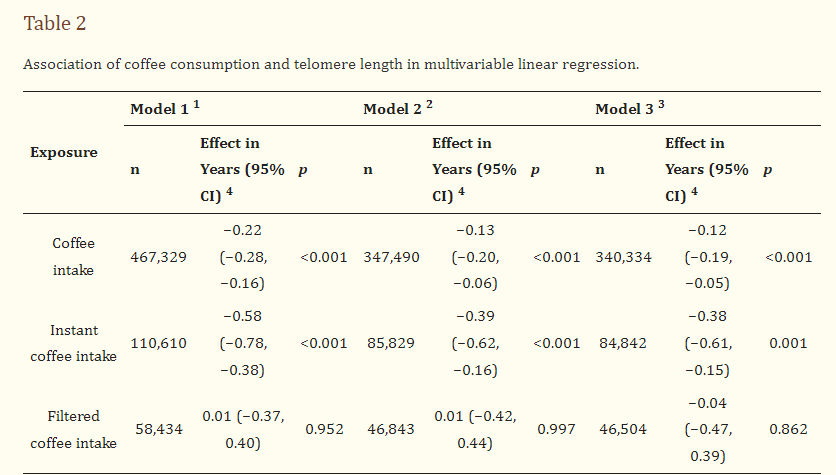
Detailed explanation of the data in Table 2:
- Exposure: The type of coffee examined (general coffee, instant, filtered).
- Effect in years (95% CI): A statistical estimate of the effect of consuming a specific type of coffee on telomere length, presented in years.
A negative value indicates an inverse association, meaning coffee consumption is associated with a decrease in telomere length.
A 95% confidence interval shows the plausible range of values for the effect. When the confidence interval crosses zero, the result is not statistically significant. - n: The number of cups of coffee consumed.
- p: The statistical p-value, used to assess the significance of the effect.
A low p-value indicates a more significant association.
Table rows:
- Row 1: General coffee consumption.
- Row 2: Instant coffee consumption.
- Row 3: Filtered coffee consumption.
Main findings:
- General coffee consumption:
- The effect on telomere length was negative (-0.12 years) and statistically significant (p < 0.001).
- This means that each additional cup of coffee consumed was associated with a 0.12-year decrease in telomere length.
- Instant coffee consumption:
- The effect on telomere length was negative (-0.38 years) and statistically significant (p = 0.001).
- This means that each additional cup of instant coffee consumed was associated with a 0.38-year decrease in telomere length.
- Filtered coffee consumption:
- The measured effect was very small (-0.04 years) and not statistically significant (95% CI: -0.47 to 0.39, p = 0.862).
- This means the study found no significant association between filtered coffee consumption and telomere length.
Possible mechanisms (hypotheses) for telomere shortening following coffee consumption:
It is important to clarify that the study showed only a statistical association and did not prove causality. The researchers proposed several possible hypotheses that have not yet been validated, and it is worth noting that the evidence regarding them is mixed:
- Caffeine and physiological effects: Coffee contains caffeine, a stimulant that may temporarily raise blood pressure and heart rate in some people.
- Possible link to stress: In sensitive individuals, excessive caffeine consumption may contribute to feelings of anxiety. Chronic stress has been linked in the literature to decreased telomere length, but this is only a hypothesized mechanism in this context.
- Effect on sleep: Caffeine consumption late in the day can impair sleep quality, and quality sleep is important for DNA repair.
Important clarification regarding oxidative stress: Contrary to what might be hypothesized, a review of human intervention studies (Martini et al., 2016) found that coffee consumption may actually protect against DNA damage and increase glutathione levels in the body, thanks to the antioxidant polyphenols in coffee. That is, the hypothesis that coffee increases oxidative stress is not well supported by the literature, and the relationship between coffee and telomeres is still not fully understood.
It is important to remember: The evidence is mixed
It is worth noting that not all studies point in the same direction. Other studies, such as the Nurses' Health Study cohort (Liu et al., 2016), found an opposite association, where higher coffee consumption was linked to longer telomeres. Therefore, the evidence on the topic is mixed, and there is no definitive conclusion.
Conclusions:
The UK Biobank study suggests a possible statistical association between coffee consumption, especially instant coffee, and shorter telomere length, while no significant association was found for filtered coffee.
However, this is an observational association that does not prove causality, and other studies have found opposite results. Shorter telomere length is generally linked in the literature to aging, but further research is needed to understand the relationship between coffee and telomeres.
References:
https://www.ncbi.nlm.nih.gov/pmc/articles/PMC10055626/
https://www.ncbi.nlm.nih.gov/pmc/articles/PMC6274123/


💬 Comments (0)
Be the first to comment on the article.