If you ask the anti-aging industry what the hottest molecule of the decade is, the answer will almost always be NAD, and more specifically its precursors. Nicotinamide Riboside, known by the abbreviation NR and the commercial brand Niagen, is one of the biggest stars in this category. It is a form of vitamin B3, it has been studied in dozens of clinical trials, and it has a compelling scientific story behind it: as we age, NAD levels in cells decline, and NR promises to replenish the stores.
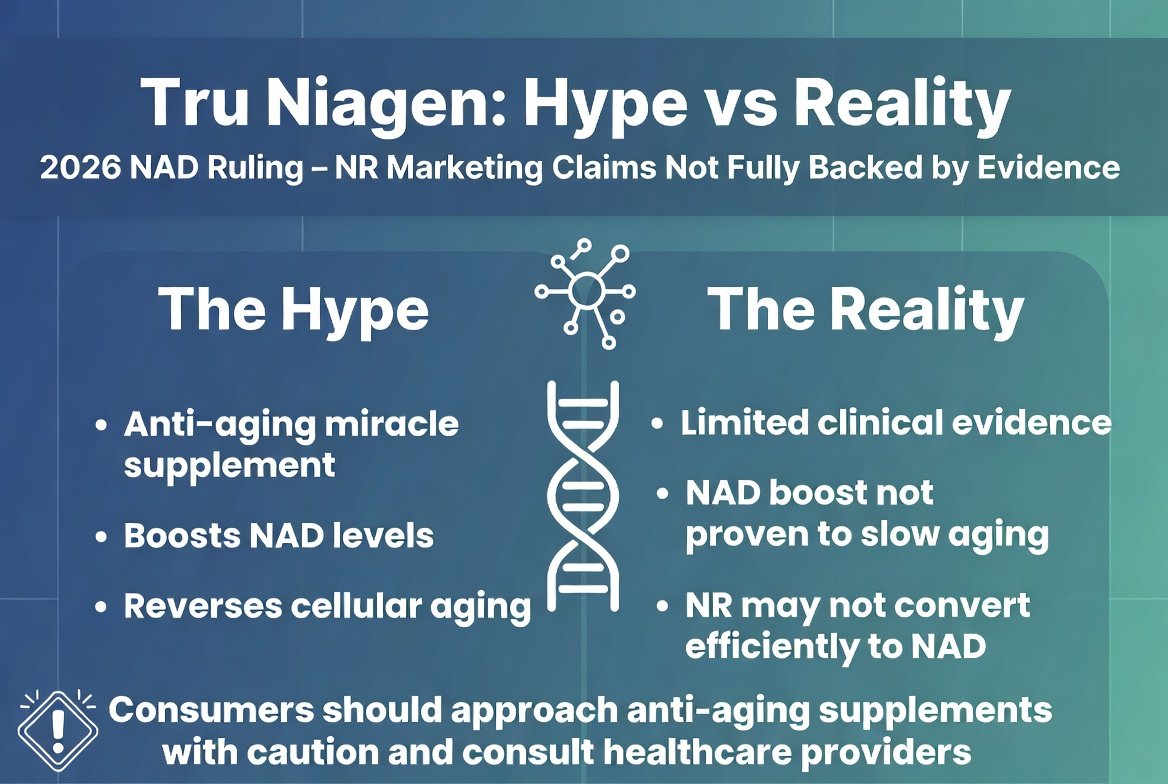
And here begins the interesting part. Unlike many other supplements that promise a lot and do nothing, NR actually does what it says on a biochemical level: it reliably and measurably raises NAD levels in the blood, and it is safe and well-tolerated. So why do we rate it red? Because between 'raises NAD' and 'extends lifespan' or 'rejuvenates' stands a huge gap that has not yet been closed in human research. In this guide, we will present the real evidence, explain the theoretical cancer concern, and show why NR and its cousin NMN sit in the same category for us.
What is Nicotinamide Riboside?
Nicotinamide Riboside is a form of vitamin B3 (niacin) that the body uses to produce NAD (Nicotinamide Adenine Dinucleotide), an essential molecule found in every cell of the body.
- NAD is a cellular 'energy currency': it is essential for energy production in mitochondria and for hundreds of chemical reactions.
- It is fuel for important enzymes: Sirtuins (longevity proteins) and DNA repair enzymes of the PARP type consume NAD to function.
- NAD levels decline with age: this is one of the observations that sparked the entire field of NAD precursors.
- NR is found in tiny amounts in food like milk, but in supplements the dosage is 250 to 1000 milligrams per day, thousands of times more.
The logic seems simple: if NAD declines with age, and if we replenish it, perhaps we can slow or reverse aging processes. This logic is exactly what needs to be tested, not assumed.
The Theoretical Mechanism: Replenishing NAD Stores
The central idea is that NR is absorbed, enters cells, and from there it is converted to NAD via a short and efficient biochemical pathway. Once NAD levels rise, the assumption is that sirtuins will work better, DNA repair will improve, and mitochondria will produce energy more efficiently. In an ideal world, this would translate to stronger muscles, healthier metabolism, and more flexible blood vessels.
This is an elegant mechanism, and it indeed works in part: the 'raises NAD' part is well-confirmed. But here lies the common mistake in the supplement world. A biomarker that improves (blood NAD) is not the same as a clinical outcome that improves (health, function, lifespan). Many interventions move nice markers in the lab without changing anything in real life. The only question that matters is whether raising NAD via NR translates to real benefit in humans. And here the research is disappointing.
Current Evidence in Humans
Study 1: Trammell et al., 2016, NR indeed raises NAD
This is the study that established NR as a supplement that 'works' on a biochemical level. A team led by Charles Brenner published in Nature Communications the first clinical trial of NR pharmacokinetics in humans. Single doses of 100, 300, and 1000 milligrams raised blood NAD in a dose-dependent manner, and in a single pilot case, NAD increased up to 2.7-fold from a single dose.
The conclusion was unequivocal: NR is well absorbed orally and reliably raises the NAD metabolome. This is the strong side of NR, and what distinguishes it from many supplements that don't even reach the blood. But note what this study did not show: it did not test whether anything in the people's health improved. It showed the precursor works, not that it is beneficial.
Study 2: Conze et al., 2019, Safe and well-tolerated
If NR raises NAD, is it safe long-term? A research team tested this in a randomized, double-blind, placebo-controlled trial of the Niagen product in 140 healthy overweight adults, who received NR for eight weeks. Doses of 100, 300, and 1000 milligrams raised blood NAD by approximately 22%, 51%, and 142% respectively within two weeks.
In terms of safety, the result was reassuring: there were no significant differences in side effects between the NR group and the placebo group, and no flushing (a known side effect of regular niacin) was reported. The researchers concluded that doses up to 1000 milligrams of NR per day are safe. This is an important point: the problem with NR is not acute toxicity or immediate danger. It is safe. The problem is something else entirely: a lack of proven benefit.
Study 3: Martens et al., 2018, A small positive signal for blood pressure
This study is the closest to 'good news' for NR. A team from the University of Colorado conducted a crossover, randomized, placebo-controlled trial in which healthy middle-aged and older adults received 1000 milligrams of NR per day for 6 weeks. Blood NAD increased by about 60%, as expected.
The interesting result: NR tended to lower blood pressure and arterial stiffness, especially among participants who already had relatively high blood pressure. This is a promising signal, but it is important to read the fine print: it was a trend, not a statistically significant result, in a small study, and the researchers themselves wrote that larger trials are needed to confirm this. It is a hypothesis that requires testing, not proof.
Study 4: Elhassan and Remie, 2019 and 2020, NAD rises but function does not
These two studies are the heart of the criticism. In 2019, a British team published in Cell Reports a controlled trial in 12 older men who received 1 gram of NR per day for 21 days. Muscle NAD increased, an anti-inflammatory signature was noted, but, and this is critical, there was no change in the bioenergetic function of the mitochondria themselves. The muscle received more 'fuel', but did not produce more energy.
In 2020, a Dutch team expanded the picture in the American Journal of Clinical Nutrition. 13 healthy overweight participants received 1000 milligrams of NR per day for 6 weeks. Muscle NAD increased, there was a slight change in body composition, but beyond that: no improvement in insulin sensitivity, no improvement in mitochondrial function, no change in blood pressure, liver fat, heart function, or inflammatory markers. In other words, NAD rose nicely, and the body remained almost exactly as it was. This is the bottom line for NR in healthy humans: the marker rises, health does not change.
What about the cancer concern?
Here we need to be cautious and honest. NAD is not only fuel for healthy cells, it is also fuel for cancer cells, which need large amounts of energy to divide and spread. This raises a theoretical concern: could flooding the body with NAD 'feed' an existing or hidden tumor?
In 2022, a team from the University of Missouri published a pre-clinical study in Biosensors and Bioelectronics that used a sensitive imaging test to track NR uptake. They found that triple-negative breast cancer cells (particularly aggressive) took up NR in much larger amounts than less aggressive cells, and that NR increased the risk of tumor development and brain metastases in mice. It is very important to qualify: this is a study in mice and cells, not in humans, and cannot be directly extrapolated to people. But combined with the basic understanding that cancer needs NAD, this is a red flag that warrants caution.
This point directly connects to NR's chemical cousin, NMN (Nicotinamide Mononucleotide), about which we have previously written in an article on the link between NMN and cancer risk. The two are very similar scientifically: both are NAD precursors, both raise NAD, and both carry the same theoretical concern. The practical recommendation is the same: anyone with a history of cancer, or increased risk, should consult a doctor before touching any type of NAD precursor.
The commercial and legal noise around it
Part of the enthusiasm around NR is not purely scientific but commercial. The Niagen brand, owned by ChromaDex, has been at the center of a prolonged patent battle against competitors like Elysium, with a court even ruling in 2021 that some patents were invalid because nicotinamide riboside is a natural vitamin. Meanwhile, the FDA ruled in 2022 that NMN cannot be sold as a dietary supplement (a decision later modified), creating regulatory uncertainty in the entire NAD precursor field.
Why is this important to you? Because when a huge industry, patents, and marketing wars are behind a molecule, it is very easy for the hype to outpace the evidence. Aggressive marketing is no substitute for a controlled clinical trial showing real benefit. The clinical evidence, as we have seen, simply isn't there yet.
Should we take Nicotinamide Riboside?
This is the part where we need to be honest. The bottom line on NR is more complex than just 'yes' or 'no':
- It is safe and well-tolerated, even at high doses and over time. This is beyond any doubt.
- It really does raise blood NAD, reliably and measurably. This is not a bluff.
- But there is no proof this translates to anti-aging benefit in humans: not in insulin sensitivity, not in mitochondrial function, and not in lifespan.
- There is a theoretical cancer concern, currently based mainly on cell and mouse studies, which warrants extra caution in those at risk.
- The price is high: 150 to 300 shekels per month for a molecule whose clinical benefit has not been proven.
If you still choose to try it, at your own responsibility and after consulting a doctor, you can check prices for purchasing Nicotinamide Riboside on iHerb, but do so with open eyes: you are paying for raising a biomarker, not for proven health benefit.
What to take from the research?
- Do not confuse 'raises NAD' with 'extends lifespan'. NR excels at the former, and has not proven itself in the latter. This is the most important distinction in the entire NAD precursor field.
- If you have a history of cancer or increased risk, stay away from NAD precursors (both NR and NMN) until you consult an oncologist. The theoretical concern is real enough to warrant caution.
- NR and NMN are almost the same story. Do not assume one is 'safer' or 'more effective' than the other; the evidence for both is similar, and so is our red rating.
- If you want to raise NAD naturally and provenly, move. Physical activity raises NAD and improves mitochondrial function, with strong evidence for longevity that no supplement comes close to.
- Invest in what works: strength training, adequate protein, quality sleep, and managing measurable deficiencies (vitamin D, B12, omega-3). These beat any expensive NAD precursor.
Want to know which supplements are truly relevant for your goals, ranked by strength of evidence? Try our personal supplement checker, which filters by age, sex, and goal, and presents each supplement with an honest green, yellow, or red rating.
The broader perspective
The story of Nicotinamide Riboside is a perfect example of the gap between compelling biochemistry and proven clinical benefit. NAD levels decline with age, NR raises them back, and it sounds like a perfect solution. But the body is a complex system, and replenishing a single molecule's store does not necessarily 'fix' aging. The human evidence, as we have seen repeatedly, shows that NAD rises but function remains almost unchanged.
This is exactly the approach that guides us at Reverse Aging: a red rating does not mean 'dangerous' or 'bluff', it means 'the evidence is not there yet, and there are question marks that warrant caution'. NR is safe, it does what it says at the lab level, but it has not yet proven it changes health or extends lifespan, and it has a theoretical cancer concern. Instead of chasing the latest NAD precursor, focus on the boring things that work: move, sleep, eat protein, and fill real deficiencies. It's not as sexy as a branded molecule, but it's what really works.
References:
Trammell S.A.J. et al., Nicotinamide riboside is uniquely and orally bioavailable in mice and humans, Nature Communications, 2016
Martens C.R. et al., Chronic nicotinamide riboside supplementation is well-tolerated and elevates NAD+ in healthy middle-aged and older adults, Nature Communications, 2018
Elhassan Y.S. et al., Nicotinamide Riboside Augments the Aged Human Skeletal Muscle NAD+ Metabolome, Cell Reports, 2019
Remie C.M.E. et al., Nicotinamide riboside supplementation alters body composition and skeletal muscle acetylcarnitine concentrations in healthy obese humans, American Journal of Clinical Nutrition, 2020


💬 Comments (0)
Be the first to comment on the article.